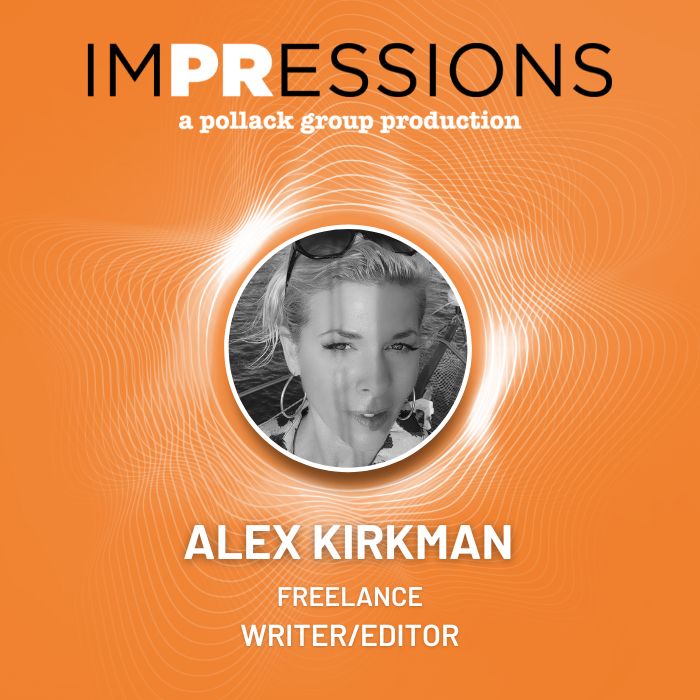
The way we communicate is changing and for many reporters, that means evolving their careers. Between newsroom layoffs and shifting editorial priorities, today many journalists are opting to leap into the world of freelancing. So, what does it take to build a career as an independent writer? Alex Kirkman, who started as an international reporter for Forbes, has been freelancing since 2013 and joins imPRessions this week to educate listeners on how to make it as a freelance reporter.
imPRessions S3 EP 18 Transcript
Jenn
Hey, Kalli.
Kalli
Hey Jenn.
Jenn
So back in 2020, during COVID, when everything was shut down and it was the pandemic, I picked up some freelance writing on the side just to sort of make some extra money and just give me something to do so I didn’t go crazy. And I’ve really loved it. I’m not sure, have you ever freelanced before just like plain old writing, whether it’s like reporting, journalism, anything like that?
Kalli
I did freelance PR and that’s actually how I landed here, but not ever in journalism.
Jenn
Yeah, so it, I mean, it’s a different world, kind of similar logistically, I think, to PR in terms of getting clients and getting story angles and things like that. But it was really, really rewarding. I got to kind of write about what I wanted, and I had a great time doing it. And I think today’s guest will be really interesting to you and our listeners. Alex Kirkman is a renowned journalist. She has worked for mainly Forbes for most of her career but has definitely spread her wings across all different publications that are top tier. She’s a travel writer, has traveled the world, visited some really amazing, iconic destinations, and has written about it. But she adds really unique spins to her stories, and she’s a really incredible writer. So, I thought it’d be great to have her come on today and kind of talk about what it’s like to be a freelance journalist.
Kalli
Yeah, that sounds great.
Jenn
I think you’ll really enjoy it. All right, let’s get to it. Okay, freelance reporters and PR professionals, this week’s episode is for you. As the media landscape continues to be disrupted, with many publications laying off talented and skilled reporters, it’s no wonder so many are opting to become freelance journalists. But what does that entail? Today’s guest has all the answers. Alex Kirkman has seen and done it all. With over 25 years of both journalism and media relations experience combined, she has worked for publications like Forbes, Fortune, HuffPost, and more. Today we’ll dive into how you can turn your ambitions of becoming a renowned reporter into reality. Hi, Alex. So happy to have you on today.
Alex
Hi, guys. Thank you so much for having me. I’m excited to be here.
Kalli
Of course. So, Alex, as you know, as Jenn mentioned, you’ve had quite a career. You’ve worked with so many iconic publications. So, I’m wondering if you could just start to introduce yourself to the audience at the beginning and give us a little insight of what drew you into journalism. Like, was there a campaign that you followed or, like a moment that you, really resonated with you?
Alex
Sure, yeah. I had always excelled at writing in school, kind of even from when I was really young. I remember I was in first grade and there was a Ronald Reagan jellybean contest that had an essay component. And I wrote an essay about President Reagan and his jellybeans. This is a long time ago. I’m a lot older than you ladies, I think. But I remember I kind of ended up on the front page of the local paper, which my mom and dad were excited about. And then in high school, I won a pretty big national essay competition. And I ended up going to UVA, University of Virginia in Charlottesville. I’m from outside of Philadelphia originally. But my only kind of plan after graduation was to try to work for a magazine. And I, at that time, I thought, basically the only magazines to work for were Condé Nast Traveler or Condé Nast in New York City. And they’re kind of, because they had such a lineup of top tier titles. So, my senior year at UVA, A friend of mine there, her sister, worked for Allure Magazine, and she got me an HR interview with Condé Nast. And then I was interviewing with a few of the top editors at Bazaar and Allure. At the time, I was temping in New York City, and another friend of mine worked for the Forbes curatorial collection. The Forbes family used to have a really extensive art collection, including the largest collection of Faberge eggs in the world. And my friend told me that she had heard that Forbes was launching a new international lifestyle magazine, and she got me an interview with HR, and then when I went to that interview, she told me it was not a lifestyle magazine. It was actually a new publication called Forbes Global, which was the international edition of Forbes magazine. So, it would be about 70% of the domestic content supplemented with 30% original reporting from story subjects outside of the US. And I, again, I didn’t think I was qualified, and she talked me into interviewing with the editor. And he was actually the founding, the number two to the founding editor of Forbes, whose name is Jim Michaels. He’s a pretty legendary figure in the business. And I remember not being very nervous because I never thought he would hire me, but I told him that I basically didn’t know the difference between a stock and a bond, but that I was eager to write. And I liked to ask questions, and I liked to think I didn’t have any kind of ego, and I really wanted to travel. I really wanted to see the world. And I remember him taking off his glasses and saying, you know, this isn’t brain surgery. And six weeks later, he gave me the job. And I think even my parents were kind of, they basically said, why did he hire you? And I said, I’m not really sure, but I’m feeling like this was a very, very lucky break. So, it kind of, that’s how it I’ll start it from there.
Jenn
Gotta love the parents that are like, really you? Because mine would do the same thing. And I’m like, why not?
Alex
Pretty much.
Jenn
Yeah, like, great. Thanks for the faith. Many, so we have found, like many of our listeners are curious about non-linear career paths. So, like, as you mentioned, you, know, got your break writing and then you transitioned to PR and now you’re back into journalism. And I know you and I have chatted one-on-one, and I absolutely love your stories, and we don’t have to dive too deep into that. But can you tell us about your experience in PR and maybe talk a little bit about why you decided to switch back to journalism?
Alex
Yeah. So, when I was at Forbes Global, I started coming up with stories that I wanted to do based on places that I wanted to go. First and foremost, I wrote about Brazil, and I went down there. I remember going on to interview a CEO of a big telecommunications company in Brazil. And then after that, I wanted to go to Italy. And I went and when Ferrari bought Maserati, I went to Italy and interviewed the CEO and the chairman of Ferrari, because I had gone to school in Rome during my junior year. And I was very into Italian culture. I’m kind of a very avid Italophile. So, I was doing really some amazing stuff, even within Forbes. Other reporters were kind of, I think they were envious of, you know, that my boss was sending me to all these great places. And then a few things happened. Forbes Global kind of started faltering. They figured out that they couldn’t really sell ads internationally. They were kind of sold regionally, so they were kind of trying to restructure the business model. And then the founding editor, my boss, Lori Menard, died unexpectedly. It was a really crazy time. And basically, I ended up going back to Forbes Domestic, just being kind of joining the reporter pool there. So, I went from doing some really glamorous kind of like hard-hitting cover stories overseas to kind of being back in the fact-checking pool. And by now, I’d probably been there for five years, and I wasn’t sure that this was the right fit for me at that time. Meanwhile, I met a bunch of publicists, PR professionals that I’d worked with on these stories. So ultimately, after spending about two more years at Forbes Domestic, I decided to make the jump to PR. One of the key driving forces of that was the fact that I needed to make more money to live in New York City. And the firm that I ended up going to more than doubled my salary. So that’s kind of how I ended up in corporate PR. I ended up going to Weber Shandwick as an Account Director, where I ran accounts for brands like Intercontinental Hotels and Highland Capital, which is a venture capital firm, and Medtronic, which is a big medical device maker. And it was really interesting and I learned a whole lot and I was still, I was kind of writing everything that was coming out of there. I wrote press releases; I would write bylined articles for executives. I would work on new business proposals. Like I still got to write, but I was also pitching and managing a team. And from there I went into, I did a kind of a 180 and went into home furnishings PR because I just kind of burned out on corporate PR after about, I guess all told, I was in it for about 5 years. And then I worked in home furnishings PR, which was a whole other world that was exciting because that was kind of my personal passion for a few years. But against that backdrop, I was freelance writing the whole time because I had a feeling, I just had like a gut instinct that I wasn’t meant to be a PR professional for the duration, like it wasn’t my strong, I was a better writer than I was a publicist probably at the end of the day. So back, I think it was in 2013, is when I went full-time freelance.
Kalli
That’s really interesting. And I, you know, you mentioned obviously as a PR person, pitching is a big part of it, but obviously that also plays a role in freelancing. Can you give us a little insight on how, like how you knew that you were going to be able to make it work? Like what should freelancers know or somebody who’s considering freelancing know? Like how do you pitch a topic to an editor and like hope that it sticks? Or is it, you know, that you’re more getting assignments, and you’re, you know, working on those?
Alex
Yeah, I mean, I think as with most businesses, you know, it all starts with relationships. Like you have to have, it really helps, you don’t have to, but it really helps to have people in the business that So, I had been on staff at Forbes. One of the first freelance gigs that I got starting, I think it was right around in 2013, was I got a Forbes contributorship. I think you guys know Forbes.com was one of the first business journalism websites. They were growing that website like way before a lot of other outlets were, and their model was to have as many, basically as many qualified contributors as they could. So, I got a contributorship at Forbes. I had pitched an editor there that I knew from when I was there before, and he liked the story, and he also let me be a contributor, which gave me a lot of kind of credibility from the drop, as well as obviously my on-staff experience at Forbes. Pitching editors, blind, without the relationships, I think it always comes down to the editor. I mean, it really helps to kind of have some kind of specialty. I mean, if you’re talking about someone who’s been a writer on staff and then going freelance, it’s a lot easier to get their attention. If somebody wants to kind of start out as a freelance journalist from the beginning, I think, you know, you have to have a couple, you know, you have to have some examples of your work that’s even going to get an editor to hopefully even read your e-mail. I mean, the thing about being a writer and an editor, I can tell you, I’m, I’m fairly well-known freelancer, I think, especially in like luxury travel, but I get probably easily at least 40 emails a day from publicists, like 4-0, which makes me think that, you know, the top tier editors at magazines, they get probably three or four times that many. So, it’s really difficult to differentiate yourself in a pitch without having a body of work kind of to stand on. We’re luckier these days. It’s a better market for freelancers in that there are so many more outlets, obviously, than there used to be, like namely. Substack. I don’t have a Substack. Apparently, I need to have a Substack, and I know a million other people that have them. I mean, I, to be honest with you, I’m not the expert to speak to about Substack, but that seems like a great place to start from what all my writer friends are telling me, you know, like just getting something, yeah, like something published, something up online, and what else, like Medium, you know, all those sites that you can kind of self-publish and try to grow a following, I mean, that is a great first step. And, also, as we’ve seen, which I didn’t have back when I started, was social media. If you can really grow your social media following and link that to, your Substack or your website or wherever you’re posting, work on what you’re doing, I mean, that also, I think, lends kind of immediate credibility to what you’re trying to do. You know, I have a lot of thoughts. We can talk about social media on another episode. But I think like having a strong social media presence and a Substack or somewhere else where you’re where you’re regularly writing and people can really see kind of your range and your, and your ability is a great jumping off point like those two in tandem.
Jenn
Yeah, that’s great advice because there are a lot of publications these days now that do welcome guest contributions too, but it might be good to kind of like have your own thing, right? Like specialize in what you want to write in and sort of have your own place that people can really see your work. So, I want to talk again, because like, again, you’ve been on both sides, PR and journalism, and you just mentioned a little bit ago that you probably get somewhere around 40 pitches a day. So what makes a pitch stand out to someone like yourself who writes across, you know, numerous publications, what would make you open an e-mail from a publicist or a PR professional and go, oh, I’m actually really intrigued by this, other than just knowing your work. Obviously, and we say this with so many reporters that we’ve had on the show, like we’ve had people from Wall Street Journal; we’ve had, like, know their work, people, like I can’t stress that enough. But other than that, what will land the story for you?
Alex
Yeah, I mean, that’s, I was going to say, I’m always looking for emails with something in the subject line, like, read your story on this or something that tells me from the get-go that they’ve actually read something that I’ve written. Because, I mean, to me, and I feel like I need to put a fine point on this, I get so many pitches about things that I have never written about, product reviews. I mean, I did, I write a technology column for a magazine called Global Traveler for a number of years, but I mean, that ended like seven years ago. And I still get pitched on like eye masks and neck pillows on planes and all that kind of thing. And then also I get pitched to like review people’s books and, you know, all this stuff that I’ve never done. And I just, I don’t know, you know, I know it’s not, it’s not easy to get reporters’ attention. But, it really, giving me some indication from the beginning that you actually have read at least one story that I wrote or gone on my website for 30 seconds just to kind of take a look at the titles that I’ve written for goes like a long way. And I’m continually blown away by the fact that most, that there are really high-level publicists that to me don’t seem to still don’t seem to do that. You know, besides that, I think like keeping it short, people, especially in this like attention economy, when I open an e-mail pitch and it’s four paragraphs long, that’s a turnoff. I mean, I think even like bullets, like saying like, hey, I think I have a good story idea for you and this is why, and giving me three bullets about what, like the thrust of the story is, so it’s easily digestible, and I can kind of get an immediate sense of what, you know, what the story might offer in terms of, you know, subject matter is really critical, because again, like everyone, everybody gets too many emails and… nobody has nearly, like time is the most valuable commodity in the world as far as I’m concerned, and nobody has enough of it. So just kind of, being short and sweet and having a true knowledge of the person that you’re writing to. Like I can’t, it sounds simple, but sometimes like the simplest things are the hardest for people to get right.
Jenn
Yeah, even us, we get pitched for the podcast because we’re on Muck Rack and Cision. And the amount of contributed articles that we get asked to, and I’m like, guys, like, please stop, we’re a podcast. Like, you could just like Google us and know that. So, like, it’s really not hard. Don’t ask us if we’re going to take a contributed article because we’re not, you know, we’re a podcast. So, it’s very, very frustrating.
Alex
Yeah, it’s just, I don’t understand it, but I try to respond to as many, as many pitches as I can if I think they’re, remotely kind of in my wheelhouse. But I don’t respond to emails that I can tell that these people have never looked at anything that I’ve written and they’re pitching something that I would never write about because it just tells me that they didn’t spend 5 minutes, you know, figuring out who they were talking to. And, you know, it doesn’t make sense for us to continue the conversation.
Kalli
No, I totally understand. And, you know, people have to do their homework. It’s part of what we’re here for. But, you know, we’ve talked a lot about the writing side. Let’s kind of switch gears a little bit to talk about what does the business side of freelance journalism look like? Because I’ve never freelanced in journalism. I’ve freelanced in PR. So, I’m wondering like, what those nuances are and how does that side of things work? Because it’s obviously less creative than, you know, coming up with different story articles. What is the process for, you know, okay, so now you’ve, an editor has said, yes, like I want to move forward with this story. Like, how does that agreement work?
Alex
Yeah, I mean, it’s generally pretty simple. I mean, you usually, the first thing to do is once they accept the pitch is they send you a contract. And I mean, I think the way it works now, usually you just sign a new contract for every, I used to have contracts with publications where it would kind of cover a time period. And now I don’t know what’s changed on the legal side, but it’s usually just a contract for that piece that you’re working on. And then that kind of breaks down the due date. And if there’s a kill fee, you know, if they decide not to run it for whatever reason, if you’re going to be compensated anything for that. And, you know, just kind of all the legalese that they have to have you sign for. I mean, beyond that, I, as a freelancer myself, my goal is to have a retainer client or two, and then that gives me kind of like steady income to do the travel stories that I do that are kind of more kind of periodic and that I might not be paid for a couple months. So, it kind of works the same way when you have like a client that’s not a magazine, you basically sign a contract and it’s an at-will employment situation and you just kind of set up all of your accounting and it goes from there. I mean, the frustrating thing about freelance writing is you often don’t get paid for pieces. They might be a net 30, meaning they’ll pay you within, they’re kind of obligated to pay you within 30 days of the invoice date, but I have a number of clients that I’ve worked with who are a net 45 or a net 60 that you’d be paid 45 to 60 days from the date of the invoice. So, I feel like all the freelancers that I know, unless they’re really prolific journalists, having a retainer, a client or two in the corporate world is, it’s really kind of like the golden ticket to be able to do the kind of freelance journalism stories that you want to do because no one else is supporting me. Like I need to be making my own money. So, I do know some lucky travel writers who they, they’re not doing it to support themselves. They’re doing it to see the world, but I kind of have to do both. So, that’s a great way to try to structure it if you can have a little work in the corporate world and then your other foot in the journalism world, if that makes sense.
Jenn
So, talk about travel. Speaking about travel, where have been some of the best places you’ve gone? I want to talk a little bit about the adventures that you’ve had. Being able to kind of pick your stories, pick your angles, pick the people you interview and the destinations. I know even a couple months ago, like you were in Africa, you were all over, very jealous. What are some of the best places that you’ve gone to in your career?
Alex
I had always dreamed of going on a safari my whole life. I’m kind of a huge fan of the natural world and I just, safari was always a dream. I went on safari for the first time in 2015. I was invited by a PR firm that I work with very closely in New York to this day for one of their clients. And I knew I would love it, but I was completely besotted by it. And I’d say since then, I was just back in Africa in May. I went to a big conference called We Are Africa, which is a tremendous like safari industry conference. And then I went on safari in South Africa and in Tanzania from there. So, I think that was like my 24th and 25th safari. So, I’ve kind of, I think if I’m kind of a generalist in some ways, but within luxury travel, I have written a number of long form stories about the safari industry and not only destinations, but kind of like industry driven stories. So, it’s amazing. I mean, I always tell friends of mine, you know, if anyone’s ever planning a safari for an occasion. I mean, I’ve been on safari in Kenya, Tanzania, Zambia, Zimbabwe, Namibia, South Africa, Botswana. You know, like I’ve really, I’ve done a lot of that. So, I feel incredibly grateful that I’ve been able to do that. And I love to write about it. I also, as I mentioned earlier, I’m a huge Italophile. I spent my spring semester in Rome and then I, you know, had an Italian boyfriend and I kind of fell in love with the language and the culture. And I’ve probably been to Italy maybe 50 or 60 times by now. Every trip to Italy, I feel like, is always a dream. And I’ve written a lot about luxury properties and luxury goods in Italy. South America, as I said, like I kind of fell in love with South America back when I was working for Forbes Global. I went to Rio de Janeiro a few times, which I think is the most beautiful city in the world. I mean, just visually. And I did some pretty big business stories coming out of South America. I don’t think South America gets kind of the kind of coverage that it should in a lot of ways, especially on the tourism side, but it’s a really incredible place to visit. And I guess my other favorite trip was I went to Raja Ampat in Indonesia, which is kind of described as the last divers paradise for various ecological reasons, like the coral reefs there are much, are in much healthier shape than in most places in the world with this, with global warming and the sea water getting warmer every day. Raja Ampat feels kind of like the edge of the universe, like the edge of the world. And I was on a Phinizi, a traditional Phinizi sailing yacht called Prana by Atzaró. I was on that ship for a week, and I did a big story about that, which I thought was one of the kind of the coolest things I’ve ever gotten to experience. So, I really, you know, I’ve been really lucky. I’ve like swum with manta rays in the Maldives and I’ve went gorilla trekking in Rwanda with the mountain gorillas. I mean, I, hopefully I’ll get my act together to eventually write a memoir because I do, I’ve had some pretty wild trips and some really beautiful adventures along the way.
Kalli
It definitely sounds like you’ve been able, like you’ve been able to do a lot and being able to incorporate journalism and share those stories, you know, that you’ve experienced as well as like the business stories and other assignments you have. That’s really amazing that you’re; that freelance journalism has given you that opportunity. Just kind of wondering from your lens, like how has freelancing changed in the last few years and where do you see it going? Like are the freelance journalists today going to be able to have the same types of opportunities that you did to work on the same types of stories? Like what kind of should they expect in taking on this role?
Alex
Yeah, that’s a tricky question. We could probably talk about that for hours because I’m not, I think the bottom line is I’m not really sure where it’s going, and I think a lot of people aren’t either. I mean, on one side of, we have kind of the legacy publications, like the big magazines that are kind of, everything is migrating to digital, obviously. There’s still a fair amount of top tier outlets that are putting out actual print magazines and travel brands, and, hotels and safari operators still really want the prestige of print. There’s still, even though everything online is obviously much more shareable and, much more, it’s much more easy to like amplify and get and get readers to view these stories; print definitely still carries some like cachet. So obviously I don’t think print is going to rebound. I mean, I think it’s inevitable that we’re all, you know, we’re all, we’re living in a digital world, and it’s only getting more and more digital. But it’s something that always I get a kick out of because I have been approached by publicists and brands that wanted like coverage in Fortune, for example. And I said, we could; we might be able to get you a story. I might be able to do an online story. And they said, well, we want, we want an imprint and online. And I said, “I can’t promise you that.” So again, the print isn’t going to be around for all that much longer, but it’s getting harder for the public or for the journalists that have been working with all these legacy publications because these publications also their stats are getting smaller, like headcount is shrinking by the day, which is driven, the why all these new outlets like Medium and Substack and these other places where you can kind of self-publish what you want to write. That’s why they’re like mushrooming the way that they are because that’s part of the, kind of the digital revolution that’s happening. The other thing that’s scaring everyone is obviously the advent of AI. Like, I like to think that AI isn’t going to take every writer’s job in the world. You know, I think there’s a lot of doom and gloom about it right now. You know, it’s obviously, it’s a looming concern for publishers and it’s a looming concern for writers because, you know, there seems to be, as we read in the news every day, a very real threat of AI, taking people’s jobs in every industry, including journalism. So, I think that’s, like AI to me, is the big scary thing on the horizon that could potentially, you know, literally change everything. But I’m optimistic that computer, like, you know, AI learning is never going to be able to replace real human writing at the end of the day. I think I have to hold on to that idea for self-preservation purposes, but I just, I don’t see how that can happen anytime soon.
Jenn
And especially all the wonderful places that you just mentioned that you’ve traveled to, while AI can probably compile landmarks and things like that, having a human through the eyes of the real experience is way different than any robot can really convey. So, I agree with you 100%.
Alex
I mean, that being said, like AI is, and I think most artists would agree, it’s a great way to do research. You know, it’s made research, like I, I did a lot of research and the advent of these AI engines, I mean, it makes it a lot faster, which is incredibly helpful.
Jenn
Yeah, use it wisely.
Alex
Exactly.
Jenn
Yeah, of course. So, before we wrap, really quick, and I know you mentioned it before, tell us one last time for our listeners who are in PR, what you cover and what type of stories stand out to you.
Alex
I write a lot about luxury travel, be it hotels or cruises. I mean, I write more about hotels and destinations than I do cruises, but I’m kind of a generalist in that’s kind of, I segued from writing about the business of luxury at Forbes to kind of going into luxury travel, largely because I love to travel. And secondly, because, you know, who doesn’t love luxury, you know, and there’s the travel market. I mean, I still think the five-star segment is booming. I mean, there are statistically not that many people with unlimited travel budgets, but it’s unbelievable, the prices that these hotels and destinations are getting from people that have the means and, want to take a private jet trip with Four Seasons around the world. Like, who wouldn’t? I just went on that trip in March. I just wrote a story about it for Fortune. And, you know, they have a new private jet journey that’s Inspired by the White Lotus; it’s $188,000 per person with double occupancy for 20 days. So, I mean, these kinds of trips are selling and they’re popular. I think we’re going to see more interesting stories coming out of that top tier of the market. Personally, as I said, Africa is one of my, is a place very dear to my heart and I’m always up for an Africa pitch. I think they’re more compelling stories when there’s a kind of a conservation element, which there usually is in any kind of respectable safari operation in Africa. I do think that the safari industry has changed a lot since COVID and they’re trying to rebuild better and stronger so that with another pandemic or another kind of global emergency that the industry will be more resilient. So, anything that kind of speaks to that within the industry is great. And as I said, like Italy is probably my favorite place in the world along with Africa. And I’m always open to an Italy pitch, whether it’s destinations or hotels and other properties. But as I said, I mean, from, I always, I think of my way of myself as a writer this way as well. I’m kind of a generalist. So any travel story that has, you know, a compelling hook, a timely, something that’s timely or tied to like the news and something that can be, you know, kind of broken down in the context of what’s happening in the world now, I think is always a compelling one.
Jenn
Yep, absolutely. Well, this was awesome. I think that that’s the perfect place to end it. You have such an incredible way of offering both insight into the world of freelancing, as well as advice for our listeners looking to delve into this career path. So, thank you so much for your time today, Alex. It really was such a pleasure to talk to you.
Alex
All right, thanks guys.
Jenn
And as always, thanks to our listeners for joining us today. Got an idea for a show? Reach out at impressions@pollackgroup.com. We’d love to hear from you. See you next time.