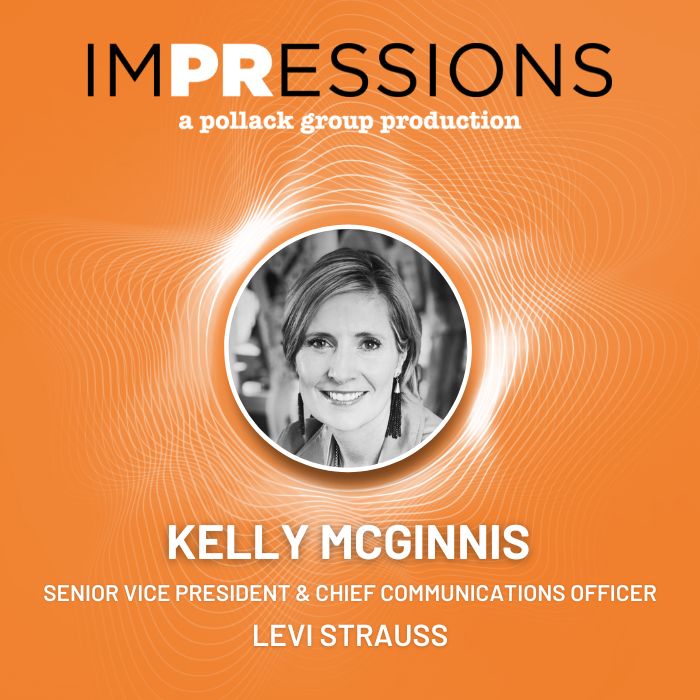
This week’s imPRessions episode celebrates a 170-year legacy. Levi’s isn’t just another fashion brand; it’s a cultural icon. Joining Jenn and Kalli is Kelly McGinnis, Levi’s Senior Vice President and Chief Communications Officer, who discusses the company’s long history of purpose-driven advocacy, its partnership with Beyonce, and everything in between. Tune in now!
imPRessions S3 EP 19 Transcript
Jenn
Hey, Kalli.
Kalli
Hey Jenn.
Jenn
So as a fellow shopper, I know you love to shop, I love to shop. We somehow nailed, not somehow, we’re awesome, but we nailed an awesome guest today that is Senior Vice President and Chief Communications Officer at Levi Strauss.
Kalli
Oh my gosh, that’s amazing. I love their jeans.
Jenn
Me too. I mean, they are so iconic. They’ve been around for over a century, which is obvious because they are great quality, and they’re just a really cool brand. They do a lot of amazing artist collaborations. Their marketing is super cool. I think there’s a lot that we can learn from Kelly McGinnis today, who is going to join us and talk to us a little bit about her role, a little bit about what goes into the communications behind the brand. And I think it’s just going to be a good conversation.
Kalli
Well, I’m definitely excited. So, let’s get to it.
Jenn
Get your wallets out. From its gold rush era roots to Beyoncé name-dropping the brand in Renaissance, Levi’s isn’t just another fashion brand. It’s a cultural force. So exactly how does a company with a 170-year legacy stay relevant? Well, today’s guest, Kelly McGinnis, Senior Vice President and Chief Communications Officer at Levi Strauss, will delve into how her team ensures Levi’s messaging stays relevant and authentic, and what her role at the iconic brand covers. Kelly, we’re so happy to speak with you today. Thank you for joining us.
Kelly
Thanks for having me.
Kalli
Of course. So, Kelly, to kick things off, can you just share a little bit about your professional journey and what initially drew you to the world of communications? We’d really like to give an idea of how your path ultimately led you to your current role as SVP and Chief Communications Officer at such an iconic brand.
Kelly
Thanks for the question, Kalli. Yeah, no, I did not anticipate working in communications. I have a master’s in public administration and worked as a social worker, and that sort of translated into working in regional government. And I did that for a while in Seattle and realized that everyone who was in leadership positions was both very young and had no intention to go anywhere anytime soon. And so had the opportunity because I had worked on public and private partnerships. And it was very early on when agencies were starting to do internal communications because I had union experience. And I had done an internship at Fleshman Hillard as part of a fellowship that I was in. Had the opportunity to go work at Fleshman Hillard and then, you know, really grew up in agencies working on big accounts and got to see a lot of large accounts and how they worked and what they did and sort of what all the roles were and stayed at Fleshman for a very long time. And then, had early in the very first sort of dot com swell, I was the head of communications at a company called drugstore.com. So, I moved to three different offices while I was at Fleshman. And then went back to Fleshman, came down and led the San Francisco office for them for a long time, and then had the invitation to go lead an agency that was dedicated in supporting Dell and commuted to Austin for several years and went from agency to in-house there. And that was my first real opportunity to lead the function. And too, I had sort of envisioned my career as being the strong #2 behind folks for a long time. But then when I had a chance to lead the function, I was like, that’s pretty fun. So did that for a long time. Had both my kids and they started to notice that mom was gone 40% of the time. So, I had to figure out a way to have a job and in the same city as my family and started to think about looking around for something in the Bay Area and had pretty much only done tech until then or had done tech and corporate things. But my toolkit was really turnarounds and transformation. And met a former colleague at a playground and heard that there was some conversations happening here at Levi’s. And so, we had a relatively new CEO at the time and had a chance to meet him. And because of some of my past agency experience, he was a longtime P&G person, and I understood the vernacular of leaders at P&G. We really hit it off, and so I got to learn a new category in industry but bring some relevant skills in that I had worked on companies that were really trying to transform themselves and reintroduce themselves to consumers. And so, I got a chance to do that and have been here a little more than 12 years now.
Jenn
That’s quite the journey. And I love that sort of happened to me a little bit in the sense where I got to learn a bunch of things kind of in one place. And it wasn’t necessarily like what I went in for the job for, but you just kind of evolve. And because you have experience in one area, your current company is like, oh, like, we would love to utilize you here and there. So, I always think it’s kind of interesting when you can, when you could bring something new to the table. And my mom also commuted from New York to San Antonio, which sounds insane. And she did that for 15 years and every two, every other week or every two weeks, she would go to San Antonio for a week and then come back. And so definitely understand the kids wanting mom at home. So, I want to now kind of talk a little bit more about your current role at Levi’s. I think, you know, since you wear many hats and have many different moving parts at the company, can you tell us a little bit about what a day in your life looks like? We know that you oversee a global team and that includes communications and public policy. So, there’s a lot involved there. Can you tell us a little bit more about what goes into that?
Kelly
Yeah, I appreciate the invitation. You know, I think not surprising, I think most of us are news hounds. So, you know, I start the day trying to make sure that I know what’s happening in the world and what I missed while during the overnight. And that’s a combination of business and financial media as well as kind of checking in on what’s happening in culture and in our trade, that we have a very specific group of publications that track sort of our world, but from a retail and apparel sector and making sure that I have a handle on what’s going on there. I will admit I have a little bit of an addiction to most of the New York Times games, so my day is a good day if I get the Wordle and the Connections, and it’s a little harder if not.
Jenn
Oh, I missed it today and I was so mad. I ruined my streak.
Kelly
Yes, well, I get you. And then I’ve been doing Duolingo for a long time as an obligation. It’s not helping my Spanish at all, but I live in California, so it seems like something I should do. And then, you know, the way that I would say no day is the same, but if I step back and think about sort of how I spend my time, it’s sort of split across three different junctures. I’d say, you know, there’s the role that we play as a member of the executive leadership team. I report to the CEO, and I sit on what we call the ELT, and that’s really an enterprise-wide responsibility that has less to do. Yes, I bring my communications hat there and have a charge of making sure that the audiences that we’re responsible for are heard in that room, but it really is an enterprise-wide piece of it. The second piece is the day job, right? When we think about sort of what we’re doing, we think about it in three buckets. We think about how are we helping to use communications as a strategic tool to drive the business, whether that’s to redefine what people are expecting protecting from us as we’re navigating becoming more of a lifestyle brand, or if it’s just really to put a spotlight on areas of the business that we want people to care about. It’s to protect the reputation of the company, and that’s either to protect our ability to operate. So, you talked about the fact that we do own the public affairs and government relations piece of it, but it’s also that protect our reputation in terms of being able to grow. And then the third piece that I spend a lot of time on is employee communications and culture. So, culture is co-owned. I mean, it’s everybody’s responsibility as a leader, but it’s co-owned between the HR and communications function here. And so, spend a tremendous amount of time on those pieces. And then I’d say the third piece is we’re a real small team. So, you know, there’s the player coach component of the day as well, where you just have to get the work done and making sure that my team members are getting what they need from me to keep things moving.
Kalli
So, you know, you said that you have a small team, but small can be very mighty. And Levi’s is such an authentic brand. And we look a lot in a lot of different companies; they use purpose-driven messaging as buzzwords, but with Levi’s, it is really deeply ingrained. Can you tell us a little bit more about your profits through principles approach and what that means, not just internally, but also its impact on the broader communities you serve?
Kelly
I mean, I think the way we like to think of it, Kalli, is that people come to work at this company because of the brand. And so many of us have, what we say, “A Levi’s Story”, but you look back and you can, there’s a moment that’s really memorable. For me, it’s a pair of cutoffs that I stole from my dad that still I break them out when I think of summer. And almost everybody has that kind of story. But when they get to know the company, they really get a deep understanding of our values. And those values have been in place for many decades. and they really do drive the operations of the company. And as you said, profits through principles is sort of how we summarize that. And it’s not something that sits over on the side that is a small handful of folks’ responsibility. It really is the way that we make decisions day in and day out. Are we making sure that we’re using the lens of our values to drive the behaviors that we want to see and the decisions that we want to deliver? And so that really is how we make choices. And it’s everything from how we set up our supply chain to how we treat our employees to sometimes taking advocacy roles on behalf of our communities. But it really is a question of, are those principles or values at the front? And are we making sure that we’re delivering on what our promise is to ourselves first and foremost?
Jenn
So, I think that’s great, especially from like an internal messaging perspective that your team kind of has those values as sort of like a bigger movement within the company. I want to ask about Levi’s and how it deals with any type of like societal issues. You know, we have a lot of brands that today are either very vocal, and they want to stand up for like marginalized groups, but then we have other brands that kind of want to remain politically neutral. And we know that Levi’s has a long history of that purpose-driven advocacy. So how do you and the brand decide when and where to engage on certain important issues?
Kelly
Yeah, I mean, I think it’s an art and a science to decide when we’re going to weigh in. It starts with, we have a very disciplined process and the same kind of two-by-two matrix that I think you see from many companies to evaluate sort of how relevant is it to our business, can we make a difference, those types of pieces. But the reality is, it’s on a case-by-case basis. It’s most effective and most authentic when it is generated and initiated by our employees. So, you can look all the way back to the beginning of the AIDS crisis and talk to our CEO then and he’ll say, you know, the reason I decided to take an activist role was because I had employees in my office saying we have to do more. And I’ve spotted that when we have a long history of having some sort of open forum where employees can ask the CEO anything. So, under the current CEO, our CEO’s name is Michelle Doss and so she has something called Ask Michelle Anything. And people can stand up and say, ask any question. And under the previous CEO, during the Syrian refugee crisis, someone stood up and said, I don’t think we’re, I don’t see us doing anything. And within, you know, a day, we had not only made a significant donation, but we had built a relationship with IRC. And you fast forward, that became a relationship that was really powerful. We even trained people in our tailor shop to learn skills and to use refugees to really develop. sort of job training as well as look at ways to use those programs. So, it really starts with our employees and then where does it emanate from there? And I would also say it’s not… these are not quick decisions. You know, when we did what we were very early to weigh in on reproductive rights, but that was the culmination of years of conversations. We have distribution centers in some of the states where reproductive rights were getting severely restricted very early in the process. And we had employees saying, we’re worried about whether or not our colleagues are going to be able to get the healthcare they need. And that initiated a conversation first with some of our C-level executives who then asked us to bring the discussion to the board. And then it was multiple conversations where we talked about sort of where do we think makes sense and it is business relevant to then when you fast forward the moment in time when the leaks happened and Roe v. Wade was repealed, we already knew what we were going to say and what we were going to do and became a real resource for peer conversations and other companies asking us, how are you making sure that your benefits are supporting folks? Because there was a whole spectrum of how people might, companies might support their employees in that situation. And because it had been a conversation that had been underway for a long time inside our walls, it became really easy for us to evaluate what we wanted to say externally.
Kalli
That’s really important. So, wondering how crucial is the internal communications at LS & Co and brands’ overall strength and employee engagement? Can you share an example of how strong internal comp supports your external narrative?
Kelly
For sure. I mean, I always kind of laugh at the end of the year when I have my performance review because what my team and I are evaluated on is almost exclusively external. But if I look at my day and sort of where we spend our energy and resources, we spend an inordinate amount of time in support of employee communications and internal. It really is what takes up a significant amount of our time and mind share. I’d say one of the examples that I’m really proud of is not only supporting the CEO succession. So we had a really unique CEO transition in 2023 through 2024, where we announced who the next CEO was going to be, but she was a sitting CEO at one of our largest customers, came on board as a president and spent a year sort of working in parallel with our existing CEO before she stepped into the role at the beginning of 2024. So that was a role where it was very much of an external announcement on the front end. It became challenge and opportunity for us on internal comms throughout that year and then to handle the transition. And then I think the example I would give you, Kalli, is as she stepped into that role, she had the benefit of having already done a year’s worth of listening to her. She had a very strong point of view on strategy when she came in. And it was our role to step in and say, okay, it’s time to refresh what we used to call the blueprint, but what our corporate strategy is. And in partnership with her and the executive leadership team, we really helped to shape a one-page summary of the strategy going forward. And that is something that has taken tremendous hold within this organization. Everybody knows those primary strategies. We reiterate them all the time, both in our earnings materials, but also when we’re talking to employees. Everyone knows what the North Star is, and it was a piece of work that we did in partnership together that feels sort of best in class, both how it came together, but how it’s being used and what an impact it’s having on our organization today.
Jenn
I love that. And I think that’s really important, especially from an internal comms perspective, that every company kind of gets that ability to do what you guys do. And I think that’s really amazing and kind of differentiates you from other companies as to maybe why somebody would want to work there, you know, that transparency and that communication and community. One thing I really find interesting about your company, and we’ve had a lot of executives on our show from, you know, big, big companies, but Levi’s might be the oldest that we’ve had somebody on our show to kind of talk about. And what I’m really curious about learning is when you have a brand that has such an extensive past, 100 and over a century now, how do you balance both the heritage with relevancy, right? Because there is a vintage appeal that I know a lot of companies still want to play on in their marketing and advertising and communications with their customers, but there is also a need in staying relevant. So how do you balance the two?
Kelly
Yeah, no, it’s a great question, Jenn. I’d say, you know, heritage, 170 years have established us as an icon. And we have a series of iconic products that people trust, they know, they believe in, and like I said before, that they have stories about that are part of how they’ve lived their lives. So, we want to honor that, but we also realize that we have to re-earn that that relevance for every generation, day after day, time and again. And so, it’s this, as you said, balance, combination of recognizing that that’s really one of our great strengths, but we have to reinvent it each generation as they get to know us and figure out, are they going to put us in their closet? So, in terms of how do we do it, I think first and foremost, the product is incredibly authentic. We’re authentic in our voice, we’re authentic in sort of how we show up, or people really know sort of what to expect with Levi’s and that Levi’s has been and continues to be sort of right there on the cusp of when culture and progress are intersecting. You know, so you look at pictures of… the fall of the Berlin Wall; people are wearing Levi’s. You look at pictures of Woodstock, people that were dressed were wearing Levi’s. It’s really when people are pushing culture forward; they’ve chosen to wear Levi’s. And so, we’ve internalized that to say, how does that translate time and again to relevant times that we’re a part of? So, I think it’s a piece of the puzzle of knowing ourselves and making sure we’re authentic to it, making sure the products live up to the promise of what they’ve always been. And then it’s the relevant partners, right? So, we’re really at our best when we’re at the center of culture. And some of the largest names and icons in shaping culture are partners to us as well. So, whether that, and I know we might get a chance to talk about it, but we’ve had a partnership with Beyoncé this past year, and it was an organic thing that she wrote a song called Levi’s Jeans, right? So that was not something that was a product placement, and it’s not something that you could ever pay for. But it was a wonderful serendipity that we were able to capitalize on. But in a very similar way, there are many, many icons who have chosen, you know, one of the, I have a large poster in my office. Both, you have both Georgia O’Keeffe, and you have Bruce Springsteen. They’re both wearing Levi’s. And so, it’s just generation and generation being alongside the folks who are shaping culture and having a really authentic relationship that’s helped us.
Jenn
That’s so cool, especially your statement about Berlin Wall to Woodstock. That’s so amazing to kind of have that iconic history and people choose Levi’s when they want to send a message. And I think that’s awesome.
Kalli
Definitely. And you know, it’s amazing to hear. I’m actually glad you brought up the Beyoncé collaboration. You know, the fact that she, you know, wrote the song like you, it’s stuff you that you can’t, like you said, you can’t, that is completely authentic. And really shows how the brand touches so many. So just wondering, like when it is like this Beyoncé collaboration, what does your team do or what have they done to maximize the impact and reach of the partnership to ensure it resonates with, you know, both the existing fans and new audiences?
Kelly
Marketing really took the lead. And in partnership with Beyoncé and her organization, they did a series of contemporary redos of classic ads that had existed in the Levi’s archives and that people who have watched the brand would be familiar with. And they put, you know, sort of this modern feminist twist on them that have been really fun to roll out over the year. And then, you know, we really looked at it as a 360 partnership. So how could we outfit her as she went out on tour? How could we make sure that those products were easy for consumers to find in our stores? It’s been really fun to watch the photos of the Cowboy Carter tour. I don’t know if you guys have seen, but she and her dancers are wearing Levi’s on stage. So, it really has been an opportunity to help us make sure that we’re leveraging every touch point to reinforce how we’re staying at the center of culture. But I would say the two big pieces that, lucky us that they happened, but we could never control. Number one was the creation of a song. So, when she launched the album Cowboy Carter, Levi’s Jeans was a song. We didn’t know that was coming, and we certainly didn’t influence it. And then on the back end, you know, making sure that we made the most of the opportunity; it’s really led to what we call the Beyoncé effect. So, women’s is a much more fragmented market, especially for jeans and denim, than it is for men’s. And so, women have a lot of choices. And the relationship that we’ve had with her over the past year has really made a difference in introducing this brand or making that reintroducing this brand to a lot of women.
Jenn
Yeah, and you know, somebody like Beyoncé, she doesn’t need the partnership, right? So, if she’s doing something, it’s because she truly stands by the company. And that’s the best credibility I think you can get.
Kelly
Yeah, Jenn, what I would say is I thank you for calling that out. And you know, I think the big piece of that is that we had a long relationship with her. We still have a pair, we have a pair in our vault of her Destiny’s Child jeans that we customized for her on their very first tour. And we’ve long been sort of a partner and a, you know, a go-to for her and her design team.
Jenn
Again, just a testament to how the brand works with high profile artists and celebrities. And she wouldn’t have wrote a song if she didn’t really feel so strongly about what you got, not only the product itself, which is fantastic, but just, you know, what the brand stands for. And I think that’s awesome. So, thank you for sharing that with us. A lot of our listeners are younger. They’re, you know, kind of getting into their field and their profession. So as a leader in the communications field, what is one piece of advice that you would share that has profoundly either impacted your career or just something that you feel somebody starting out that maybe wants to get into fashion or get into communications, what would you share with them as something that they should do from the very beginning?
Kelly
Yeah, I mean, it’s going to be not as pragmatic as perhaps your question is, but I say this to my students. I teach a graduate level class as well. I think the thing to do is to really listen to your gut. And when you feel fear, keeping you back, that’s the thing that you have to run towards. So whether that is keeping you from feeling like you can embrace a change in your career because you feel really comfortable, because you know all the people, you can navigate it, whether it’s “I don’t know the answer, so I’m not going to speak up”, but when you can feel in your stomach that you’re making a choice that’s limiting you and it’s coming from fear, that’s exactly the thing that you should go for. I really wish I had known that much earlier in my career, because when I look back, the places where I had moments of stagnation, was when I was thinking, well, either this is as good as it can get, or I’m going to put too much at risk if I change it. And those were really decisions made by fear.
Jenn
Yeah, wow. And that’s great advice. I think pushing ourselves is definitely the way to go in business and in life. You know, do something that scares you. I think that’s perfectly said and a great piece of advice. Kelly, this has been such a great conversation. We’re so excited that you came on the show, that you shared your insights with us, and we really, really, really appreciate the time. So, thank you.
Kelly
Thank you both. I really appreciate it. It was a fun conversation.
Jenn
Thank you. And thank you to our listeners for tuning in. Be sure to follow us on all Pollack Group socials for imPRessions updates and new episodes. As we’re closing in on season three, reach out with any guest recommendations for season four at impressions@pollackgroup.com. Bye for now.