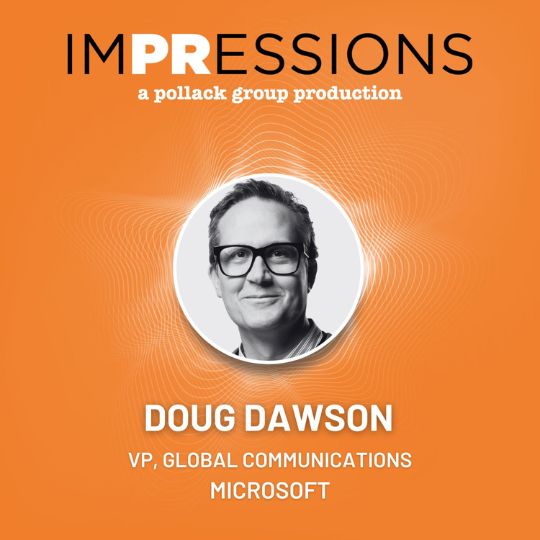
For half a century, Microsoft has been at the forefront of technology and innovation. As one of the most influential companies in the world, Microsoft faces a unique set of challenges: staying human, trusted, and consistent while operating across countries, cultures, and industries at massive scale. This week’s episode welcomes Doug Dawson, Vice President of Communications at Microsoft, for a behind-the-scenes look at how one of the world’s largest brands manages its marketing, PR, and communications. Jenn and Kalli unpack global storytelling, AI, and more.
imPRessions S3 EP 21 Transcript
Kalli
Hey, Jenn.
Jenn
Hey.
Kalli
So, happy season three finale.
Jenn
What a ride.
Kalli
Yes, we’ve had some really great guests this season. So, I’m excited to end on a high. Today, we are lucky enough to have a guest who is literally putting the global into global communications and world-class PR. Doug Dawson is Vice President of Communications at Microsoft. And today we’re going to talk about how he creates one consistent voice for such a huge, massive, multi-layered company.
Jenn
Well, what a way to end the season. I mean, we’ve had some amazing guests on. Some, you know, big brands, and I don’t think there’s a better way to have our finale than with someone from Microsoft. So, excited to hear what he has to say.
Kalli
All right, let’s kick it off. From powering classrooms to redefining what’s possible with AI, Microsoft isn’t just a tech giant. It’s a global force shaping the way we live and work. So how does a company of this scale stay cohesive, trusted, and relatable across borders, languages, and industries? Today’s guest… Doug Dawson, Vice President of Communications at Microsoft, will unpack how his team keeps Microsoft’s voice consistent, responsible, and visionary, from high-stakes AI partnerships to real-world impact stories. Doug, we’re so thrilled to speak with you today. Thank you for joining us.
Doug
Oh, thanks for having me. Pleasure to be here.
Jenn
Yeah, hi, Doug. So, I want to go right into your mantra, which I love. And for our listeners, it is “putting the world into world-class PR”. I’d love for you to take us through how that idea kind of shows up in Microsoft’s global comm strategy and talk a little bit more about the ideation behind that.
Doug
I’m happy to. Yeah, it’s been our mantra for the past couple of years. I would say two years ago, we restructured our communications organization at Microsoft, and we are all now one part of a single organization. And we spent time discussing, what does that really mean? And what does world-class PR look like in a global communications organization? And ultimately, what we concluded is it starts with listening. I think that’s the most underrated communication skill, and it’s listening. And we started there because excellent communications just isn’t about broadcasting messages. It is about finding relevant stories that we tell locally. All storytelling is local. And so, it’s important for us to listen, lead with relevance, and we built our communication strategy upon that. I mean, yes, we have kind of shared narratives. We have our, for Microsoft, our shared narrative is how do we position ourselves as the most trusted and most innovative partner in every market in which we operate? That’s our global goal. But what does that mean from a local perspective? And this is where we give our teams a lot of flexibility and freedom. It might be AI and agriculture in India, for example, or that same story in Sweden has a greater focus on sustainability and job creation. And our mantra of kind of putting the world into world-class PR starts with that listening and empathy and then putting our storytelling that reflects the individual markets in which we operate in the broader world that we serve.
Kalli
That makes a lot of sense. And, just kind of wondering, as you mentioned, and as we all know, Microsoft is an extremely massive and very layered company. So how do you keep the global communications strategy cohesive, especially when every region has its own priorities, its own tone, you know, its own considerations? How do you keep it all together?
Doug
Like that, I think you’ve just nailed one of the most challenging elements of the role. Our operating model really is one based on flexibility. As you point out, you know, we’re trying to cater to the needs of various audiences and various markets and various regions around the world. And, you know, for us, we try and focus on anchoring around a few core narratives. I mentioned earlier, our focus really is on positioning Microsoft as the most trusted and most innovative partner in every market. So, trust and innovation are these kind of core communications pillars. But we also need to build in flexibility to ensure that we’re empowering our teams locally to kind of bring those narratives to life and also make sure that we have the flexibility to adjust for what that local dynamic requires. So, it’s a balance of orchestration and autonomy. And I think one of the reasons it works is that we have this kind of shared planning model. We apply these deep local insights, and we build this foundation of certain things that are fixed and then ensuring that we have lots of flexibility in our communication strategy at a local level. So, it’s that balance of fixed and flex and that ability to adapt to the needs of the local markets.
Jenn
And what about AI as one of those pillars? Because Microsoft obviously has been around from the get-go of the internet boom, right? It was one of the first major companies, and I’m aging myself probably for most of our listeners, but when I was growing up, the internet was kind of in its early stages. So, but Microsoft is one of those companies that always rolled with the time. So how are you approaching the challenge of AI and telling a story that’s responsible and visionary, but also still relatable and easy for your audience to understand?
Doug
Yeah, you hit all three of the core tenets of great storytelling. I mean, you want to inspire, right? We want to create a vision of innovation of what this technology is able to do. But it can’t just be about creating this hype cycle. And so, we aim to lead with responsibility. And our AI story is grounded in those principles, these principles of transparency, accountability, fairness, but brought to life through genuine real-world impact. And so, a lot of our storytelling focuses on real world examples, either through individuals, what customers are doing. You know, there was a recently a great profile piece in the Wall Street Journal on how Clorox was, as a brand, was using AI to help them with marketing innovation. Very recently, we did a story about a student in Kenya who was using AI as a learning tool. And we brought to life how technology really empowers people. Empowerment is a core theme for all of us at Microsoft. It’s printed on our bench. Our corporate mission is, what does it say here? “Empower every person and every organization on the planet to achieve more.” And artificial intelligence is a tool to help us achieve that. And so, for us, it’s balancing innovation with responsibility, and we think that’s the sweet spot for great storytelling.
Jenn
Yeah, absolutely. And I think that you kind of nailed it too with AI, because there are so many… I guess, controversies around it right now and how it’s being used. But it really, if used correctly, it really can be a tool to enhance education, to kind of help with the mundane. No, you shouldn’t be using it to write books and music and things like that and plagiarize whatever, but it definitely can be used as such a great source for personal and professional growth.
Doug
Yeah, I actually, I’m going to steal this. It was a journalist who gave me this metaphor where he looks at AI like a time machine, and that it is literally a tool that helps you create time. It can automate certain mundane tasks. It can shorten the time of doing, you know, research. It can help you prepare a first draft of a document, you know, any press materials. It can create a first draft of a, you know, a visual, accompanying visual. And it’s what we do with that time that we save is the real magic. And so, if a tool can help me save, 2 hours a week of automating, some mundane administrative work, that’s, 2 hours a week I can apply to something else. That’s 100 hours a year I can apply to doing something far more productive. And it’s that time that is the gift. And so, I’m starting to really like that metaphor of this time machine approach in that it doesn’t send us off into the future. It creates time in the present for us to be either it could be more productive, could be more creative. I think we’re all experimenting with how we’re using AI on a day-to-day basis. I’ve been using experimenting with my copilot AI. I call him Bob. You know, we’ve gotten to the point now where my wife is asking me, it’s like, hey, ask your friend Bob. This question or that question. And it’s really become somewhat transformative. And again, big, big, it’s, for me, it’s just; it’s saving time that I can invest elsewhere.
Kalli
I’m actually really glad we’re talking about this because especially right now, we’re in a moment where the trust in big tech, it can be very complicated. I’m sure you can trust Bob like he’s your best friend, but somebody else may be questioning, well, how does this all work? So, I’m curious, how is Microsoft working to build and maintain trust, especially in parts of the world where tech adoption is extremely high, but so is the regulatory pressure?
Doug
Yeah, no, look, great questions. And it also speaks to the global landscape. There is no one uniform market. There’s no one uniform strategy. I think the one uniform approach that we take is, responsibility is paramount, and responsibility is the key to building trust. And that also means transparency, like where does your data lie? How are we using, how are we training these models? And I think it is, trust is built through a steady drip feed of demonstrating responsibility. Trust isn’t built through press release. Trust is built through taking concrete actions. Trust is also about accountability. No one is ever going to get it right all the time. Trust is built when you’re quick to respond to something that didn’t go as planned, you’re transparent about it, you’re focused on solving problems, and over time, if you’re consistent in that approach, that is how you build trust over time.
Jenn
Absolutely. And, you know, Kalli and I are in PR, right? So, trust is essential in our line of work and with our clients and with the media. And this kind of goes into the next question I wanted to ask you, because, you know, in our world, something can happen in the blink of an eye, and we have to immediately pivot. So, when something global affects Microsoft and sort of happens overnight very quickly, whether it’s something political or regulation or any type of crisis, how does your team respond in real time and sort of tackle that without losing that trust that we’re also just kind of talking about, like consumer trust? And just kind of keeping everybody, okay with what’s happening. How do you deal with something like that from such a big global company like Microsoft?
Doug
I like how you phrased the question, “if” something goes, it’s more “when”.
Jenn
Yes, I’m trying to be positive here.
Doug
Look, I love it. I love it. I’m sometimes too much a realist. But it’s a super valid point. I have this expression I’ve used for a decade, but we write our plans in pencil. Maybe pixel is a better analogy, but we need to plan for agility. And this is where muscle memory, great training comes into place. But we have built our team. We’ve structured that team to respond quickly. And I think what guides us is just a clear set of principles. And that frankly allows us to pivot without losing the plot, right? The other thing that we do, and look, we deal with what I would call problems on a regular basis, not crises, but public problems on a regular basis. And it goes back to that principle of trust. And taking accountability, providing maximum transparency, when possible, and… ultimately staying focused on what matters most to our customers, the communities in which we serve. It is not about headlines. It is about customer outcomes. And when you have that as your North Star, it guides your communications in a very deliberate way. Let me give you an example. You might recall, I certainly will never forget, it was a very hot day last July. And a security vendor published a software update that ended up crashing millions of PCs around the globe. I’d like to say I remember that day fondly.
Jenn
Yes, I do remember it because I think they believe Teams was down. It was like even if you didn’t have a Microsoft computer, like you were still dealing with some type of ramification.
Doug
You were like I remember vividly. I was actually visiting. I was just wrapping up a visit with my team in Spain, and it was 42 Celsius or 110 degrees, and I’m in the Madrid train station of this sweltering summer heat, working with our issues management team, our legal, our security, corporate affairs. While this became clear very quickly that it wasn’t our fault per se, it was certainly our problem, and our many customers were in real pain. And so here is where our core principles really shone through. It’s like, it’s customer first. And that’s where we dug in. And over the next 72 hours, I would say about 72 hours, right across the globe, we activated teams with a single focus, help get our customers back up and running. And as painful as that experience was in the short term, I think our approach, our very principled customer-first approach… this wasn’t about finger pointing. This was about rolling up our sleeves, helping the people who are in pain solve that problem. And that, I believe, helped us earn trust and really became a moment of a, we took a challenge, a really difficult, painful situation, and turned that into a moment where we could win back the trust of customers.
Kalli
I remember that day fondly. And, you know, it’s so funny that you say, then just even thinking back on it, that you’re saying that you win back the trust of customers. I remember just being in that situation and even how everything was handled, like not really worrying about it. Like I knew everything was going to be fine. It was going to get back up online, whereas if it was another company, I don’t know if I would have felt the same way. Like it would have been a little more stressful and maybe not handled in the same way, but it also goes to show like, especially with Microsoft being so large, Microsoft touches everything. So, whether you’re responding to a crisis or launching a new product and everything in between, how do you approach storytelling in a way that feels consistent and authentic across such a broad range of sectors and audiences?
Doug
Look, A, thank you for that polite compliment. I will certainly tell you in that short 72-hour window, it was a particularly stressful time. And yet, as you say, I do think it was a moment for us really to demonstrate, that core set of principles, our customer-first focus. This wasn’t about pointing fingers. It really was about solving problems. And that is something we try and apply, you know, 365 days a year. You make a really great question about simply the breadth and complexity of being a storyteller at Microsoft. You’re right, you run from Azure to Xbox and everything in between. And it is a large, complicated company with operations around the world. And so, it’s imperative for us from a communication standpoint is to find that streamline. We try to avoid scenarios where we’re trying to boil the ocean or we’re trying to tell stories to everybody, every particular audience, every market at the same time. I mean, that something doesn’t, that doesn’t work. And so, we really look for those through lines. I talked about trust and innovation. Those are two key through lines. You know, another one for us is empowerment. And this is the benefit of working for a company like Microsoft; we’re in the software space, and our products serve a common purpose to empower customers, technology users across the globe. And so that could be something as specific as a GitHub, Copilot story, but it’s also perhaps working on a story about gaming and how we’re exploring new worlds. It really is grounded in this notion of empowering people to achieve more. And when we look at things through that lens, that really helps us with a forcing function on identifying, okay, what stories do we want to put our energy and effort behind, and which ones are just going to have to be left on the cutting room floor. You know, we often have this incredible, you work for a company of this size and magnitude, on any given day, there is, an opportunity to tell a story. But you’ve got to be mindful. And sometimes we need to leverage constraint and making sure that we’ve got great focus and that we’re putting more energy; we’re putting more wood behind fewer arrows, so to speak. And so that we are telling stories that are able to cut through the noise and not just contribute to it. And that takes discipline; it takes rigor, but it also takes some consistent focus on finding those through lines.
Jenn
Yeah, absolutely. And I want to kind of dial back a little bit to what you were just saying before about innovation, because obviously that is a very important part of any big company, especially Microsoft. But then you also have people, customers that they love when big companies do great things. Of course, it’s creative and it’s fun, and we want to buy these new products and the new Xbox, and things like that. But they also want to see companies doing good for giving back to, sustainability or helping with charities, anything like that. Can you tell us like how Microsoft sort of balances the two, both the innovation of great ideas and amazing products and marketing, but also, you know, gives back to real world impact? Is there any campaigns that you’ve done that you feel proud of or anything you could kind of talk about that sort of gives the balance of the two?
Doug
I love that. And it is finding the balance of the two. I mean, quite often, and as fellow communicators, I think we all feel this. We’re often under the pressure of dealing with stakeholders who sometimes miscategorize new as news. And, you know, the world is full of, okay, new this, new that, new speed, new feet, new gadget. And short term, you know, those make for some creative pops, but they don’t always contribute to kind of longer term, robust, or frankly, stories that resonate. And this is where you’ve got to find the right balance. Like innovation is a tricky one, where we can talk about wanting to achieve this perception of being an innovative partner. But if you ask or if you listen to anyone, say, hey, I’m innovative, the first thing you typically do is tune them out. Innovation is not something that you say about yourself. It is a perception that you earn over time. It’s by what you do, the products that you create, the experiences that you’re able to enable, how you partner with others. That’s what creates real innovation. I love to see innovation come to life in that it might be this unintended or unexpected outcome of a new technology. That to me is where innovation comes from, not what we say is innovative, but how it is being used. And then to your other point on what makes stories resonate; it really goes back to the core tenets of great storytelling is, appealing both to the mind and to the heart. And often we start with the heart. We want to win hearts and minds in that order. And so great stories resonate with us emotionally as much, if not more, than they may do rationally. So, this is partly where you were trying to find, you know, great heroes for these stories. And, you know, our approach at Microsoft is we should never be the hero of our stories. Let’s use the example of someone who might be using this technology, an IT manager at a customer, how he uses technology to prevent a security breach, that’s a heroic effort. Let’s focus on those types of stories because we think those resonate more. And so again, trying to find the right balance of innovation, but having real world impact. Those are the stories that we see resonate more than simply about, new speed, new feed, new feature. Those are a little bit like sugar rushes. You get a little bit of a pop, but they don’t have any long-term resonance.
Kalli
So, Doug, I’m glad that you mentioned the different opportunities that have come out of, you know, come out of innovation. And we all know that there’s not every story is a feature story, and there are so many different mediums coming into play, coming back into play, and we’re consuming more information now than we ever have. So, how are you adjusting the playbook to meet shifting demands and the ever-changing media environment?
Doug
Great question. And as one, we are asking ourselves on a regular basis. You’re 100% right. We are consuming more information today than in history. That said, we are getting our information from a number of different sources. It is no longer sufficient simply to be landing that feature story in the New York Times, Le Monde, The Guardian, those key print online titles. We’re in a world now where people are consuming information through mediums like this, over a podcast. Newsletters are again, continue to be in vogue because they are able to really dive into a singular topic, whether that’s a newsletter format, a Substack, on a Reddit. You have a generation of, I would say, news consumers who get all their content on a mobile phone. And so, we’ve got to make sure as communicators that we stay relevant; our storytelling adjusts to a range of platforms. At Microsoft, we’ve coined this, creating that surround sound communication. So, we want to get that great traditional media feature piece, but we also want to be engaging with key online influencers to make sure that we’re expanding that narrative and extending that narrative to the audiences that they reach. You know, what is our social strategy, whether it’s on LinkedIn or Instagram, TikTok, and others? We always make sure that we’re thinking about what is our own channel strategy, a hugely important opportunity for brands today, where brands have far greater permission to tell their own story, providing they do it in a, you know, I would say a journalistic format. It’s not a, you know, just promoting marketing material, but you know, if you tell your story in a way that’s credible and relevant, we’re seeing those type of stories really resonate. And that for us is building that, what we call that surround sound approach. And I think that is the new playbook for modern communicators. As we adjust to a far more fragmented media environment, we have to have a corresponding media strategy that looks a lot different than what it might have done just five years ago.
Kalli
I could not agree with that more. And I really love your approach, the surround sound approach. It really makes a lot of sense. And it’s no surprise that Microsoft, they’re the future of responsible tech, but also driving this global communications movement. So, really, thank you so much for taking the time to share how your team approaches global communications with clarity, trust, and impact. So, thank you again so much and for giving us a behind-the-scenes look on how Microsoft tells its story to the world. And to our listeners, thank you so much for tuning in this season. Make sure you’re following us during the break on social media for updates on future seasons. And feel free to reach out with any questions or guest suggestions for our next season. You can reach us at impressions@pollackgroup.com. Bye for now.