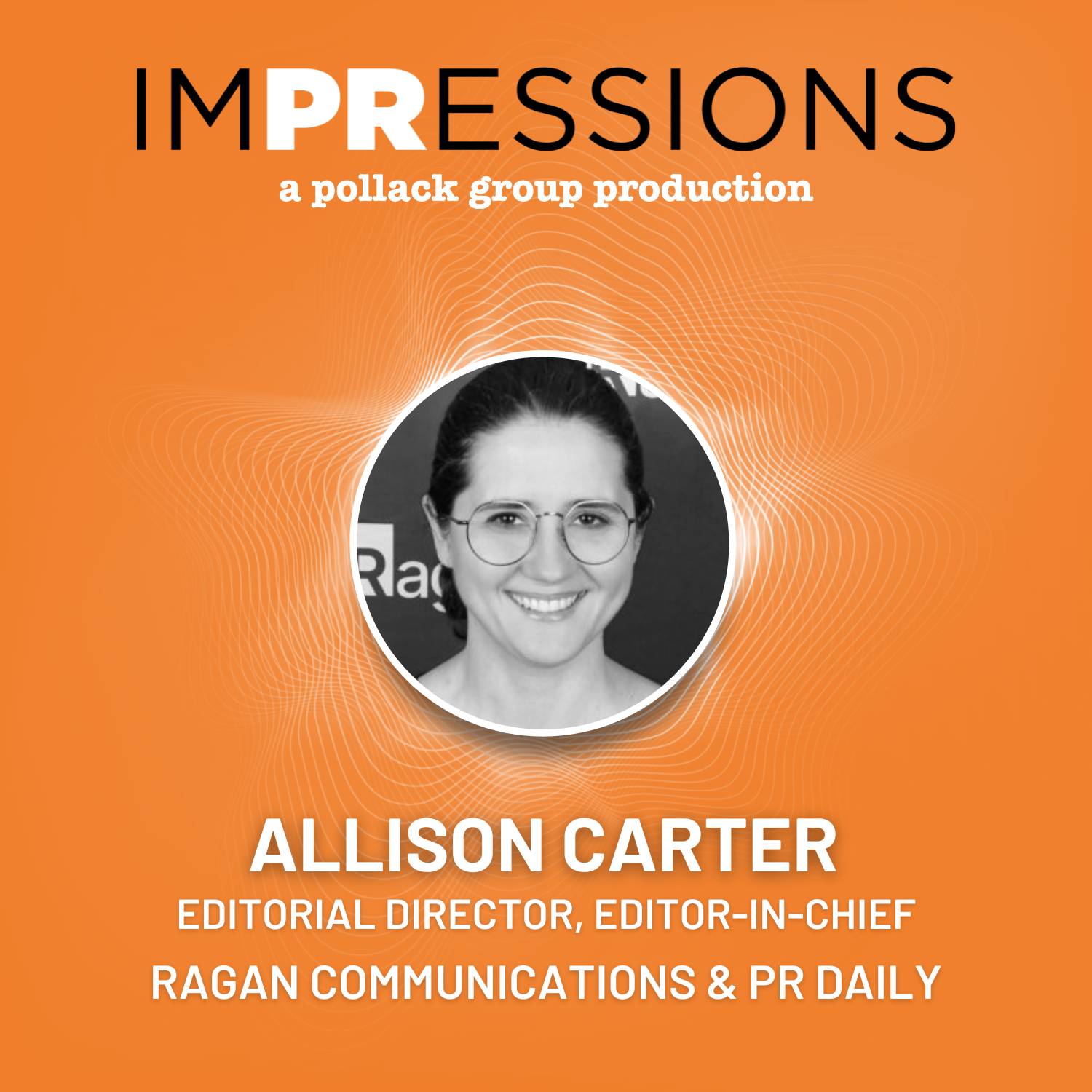
PR professionals know the thrill of landing a placement in a top-tier publication. For clients, big names equate to big wins, and while mainstream media is usually an indicator of success, one important medium is often overlooked: trade media. In today’s episode, we sit with Allison Carter, Editor-in-Chief at PR Daily, to unpack why trade media needs a front row seat in every PR strategy.
imPRessions S4 EP 4 Transcript
Jenn
Hi, Kalli.
Kalli
Hi, Jenn.
Jenn
So as a PR professional, how often do you read any of the PR trades? Because I know for our clients, we have clients across all different verticals and all of these verticals have their own industry trades, right? You have Food Dive and Industry Dive. Well, there’s a PR Dive. I mean, there’s even something for our industry. Do you find yourself kind of following them on social media and signing up for their newsletters?
Kalli
Yeah, I do. I like to keep my thumb on the pulse of what’s happening in the industry.
Jenn
Yeah, same. It’s just really interesting for us to kind of just get an inside look as, you know, what’s happening at other agencies, what other PR professionals are going through. So today I invited Allison Carter, who is the Editor-in-Chief at PR Daily. And she’s going to talk to us today about what it’s like to be Editor-in-Chief, some of the PR trends that she’s seeing in the industry. And I think, you know, it’s going to be a learning conversation for us as PR people to really hear from her and hear what she’s seeing on the inside. And then for our listeners too, maybe if people are trying to get into PR and they want to learn a little bit more about the trade or people like us who have been in it for a long time and maybe just haven’t been keeping up on the trends and the tabs of what’s happening. So, I think this conversation is going to be a really interesting one for us.
Kalli
Agreed. I can’t wait to get to it.
Jenn
Great. Let’s welcome Allison now. PR professionals are used to pitching top-tier journalists. From Forbes to Wall Street Journal, B2C media is what keeps our clients happy and us on our toes. But what about trade media? From industry dives to insider analysis, trade media shouldn’t be overlooked. In fact, it helps mold conversations that influence our peers and the future of our profession. Today we’re excited to welcome Allison Carter, Editor-in-Chief of PR Daily, to discuss the importance of trade media, especially in a world as nuanced as PR. Hi, Allison. Thank you so much for joining us.
Allison
Hey, thanks for having me.
Kalli
Of course. So, Allison, you know, as the Editor-in-Chief of PR Daily, I would love to just take a step back for a second and start at the beginning. You know, where did you start your career in journalism?
Allison
Sure. So, I actually started my career in journalism a little bit late. I did things backwards from the way that most people do. My degree is just in what at the time was called strategic communications, which is basically the PR degree at Elon University. And when I graduated, my first professional job was at a small business marketing agency right at the very beginning of the content marketing and social media era back in about 2010, back when those things were very new. And I ultimately wound up with a role doing social media for the Indianapolis Star, the newspaper in my hometown. They were looking for someone who could help promote their editorial content on Twitter and Facebook were the big players at that time. And so, I really came in through the window of journalism, so to speak. But, you know, from starting in social media, I eventually did become a more traditional editor at the Indianapolis Star, covering everything from breaking news, crime, mass shootings, you name it, COVID, street protests, federal executions, as well as entertainment, arts, weather, you name it. I probably edited it at some point while always keeping my hand very strongly in digital presentation, headline writing, and audience work. After the pandemic, that was a very difficult time to be in local news, and I saw this opportunity with Ragan Communications and PR Daily, and it really seemed a perfect combination of the two halves of my career. I was able to keep my journalism chops and bring rigor, talk to people, write stories, while also, you know, getting back into this world of PR, marketing, communications that I was in very early in my career. So, I’ve been there four years, next month, and it’s been just a wonderful fit for me.
Jenn
Yeah, that’s very interesting. And what I love too is you sort of have a little bit of everything kind of under the PR marketing umbrella, which probably really helps with your day-to-day. And we’ve had a lot of people on our show that have either started in journalism, mostly start in journalism and then transition over to PR. I haven’t seen too many people that start in PR and then transition over to journalism, though I’m absolutely sure it’s a thing. So as Editor-in-Chief, I would love to hear a little bit more about what your role is at PR Daily. And then if we can talk a little bit about the role of trade media today. A lot of our listeners are in the PR industry. So this is a really important topic for them because it’s not just about trade media in terms of, okay, I can get, my food and beverage client in Food Dive, which is really important, but also like from PR to PR, what are some of the benefits of PR Daily that PR professionals like myself and Kalli, what should we be reading about, what should we be looking at to kind of, you know, spruce up our own knowledge and information about the industry that we work in?
Allison
My role at PR Daily, so I actually go over to… oversee two publications at Ragan Communications, PR Daily, which obviously focuses on external communications, as well as Ragan.com, which is focused specifically on internal communications. Obviously, there’s a lot of overlap between those two disciplines. They work together very frequently, so it makes a lot of sense for me to oversee both of them. I also supervise two very talented reporters. Courtney Blacon focuses more on PR Daily, whereas Sean Devlin focuses more on the internal communication side for Ragan.com. So, I’m very fortunate to work with them. So, I get to edit them, work with them, you know, help develop them as reporters. I also am a player coach, so I’m also writing content for the sites in various forms. Events are a really important part of our business, so I am frequently traveling to conferences, award ceremonies, retreats, other events that we have as part of the company. I’ll be in a couple of weeks in Fort Lauderdale for our AI Horizons conference. So, at those, I speak, I do coverage, I source, all that fun stuff. But mostly the most important thing that I do is I talk to PR professionals, figure out what is keeping them up at night, what are their big concerns, what resources do they need to do their job? Because particularly on the PR side, there’s plenty of competitors in the PR space, right? I’m sure that you don’t need to list them. There’s great people doing great work from a variety of different publications. A lot of them, however, have a slightly different focus. Maybe they’re focusing more on personnel moves or who became the AOR. Some of them are looking at more inside the industry, insider baseball kinds of things. At PR Daily, we really focus on information that you can take and do your job a little bit better. We really focus on professional development. And I want to be clear; there’s room for all of those kinds of journalism in the industry. It’s all important, but that’s kind of our niche. And that’s really what I’m passionate about, is that kind of utility or service journalism was what motivated me when I worked in local media, and I’ve carried that ethos through to my work in PR Daily. So, I also edit work from contributors. I work with sponsors in various capacities. I post too much on LinkedIn. So, I work in just a variety of capacities to have as much contact with folks in the industry as I can.
Kalli
That’s really great. And it definitely sounds like you yourself are very busy and have so much going on. But one of the things that you had mentioned was that there are different types of coverage that are coming out, different AR, things like that. So, with so much noise in the media ecosystems, what is it that makes trade publications special? Like why did they still matter? you know, in all of this noise.
Allison
Sure. I think that there’s a couple of reasons. The first is that people need to know what’s going on in their specific niche. They need professional development. They need to understand trends. They need to know how to do their jobs better. And sometimes they need to gossip with each other and, you know, see where the pieces are falling. And I think those are all really important for people. But as we are… more fully enmeshing ourselves with AI, we know from great research, like for instance, the Muck Rack GEO report that everyone has been reading, that earned media is a significant driver of both search engine placement as well as placement in artificial intelligence search results. And so, as a result, I think trade media is really becoming more important than it has been in quite some time, simply because it has such high credibility with these sources that everyone wants to be in. And so as more traditional media continues, very sadly, to shrink and face difficulties, I think you’re still seeing some vibrancy in trade sectors simply because they can be funded in slightly different ways through events and awards and other means like that, I think that’s why you’re still seeing so much interest in people getting placement in these particular specific publications.
Jenn
Absolutely agree with you there. And I think that you’re right. I don’t know. We were kind of talking about this before. We talk about this all the time in our agency. And I kind of mentioned this in our opening, you know, when you bring a client on, a lot of times, right, they want the big heavy hitters. They want to be in USA Today and Forbes, and they really don’t understand the value of trade media and how important it is. And sometimes our PR professionals also kind of lose that because they want to make, you want to make your client happy and you want to be able to say, oh yeah, I secured, you know, CNN and I secured all this and all of that is great. But there are other important values I think that can sometimes get overlooked. So, what do you think some of the misconceptions are that PR professionals have about pitching trade outlets other than what we just talked about. Other than the, my client wants to be big in, this really big publication. What are some other common misconceptions that you see as somebody who works on the inside? And what would you say to some of those people that have those thoughts?
Allison
It comes down to not, in some cases, obviously they’re in, if you’re working with a big B2C brand and you’re trying to announce a new rollout, yes, you want to be, you cast the widest net possible. You want to get the most attention possible. But in many cases, you have a more narrow goal. You have a more narrow audience. You don’t necessarily need to reach everyone in America, which of course you’re not going to do anyway these days, which with splintering audiences, your slice of the pie is getting smaller and smaller. And so, to that end, you really need to think about what is my goal with this placement? Because if your goal is just impressions, that’s such a blunt instrument. It might be feel-good. Everybody loves saying I got 8 billion impressions. And it’s like, no one seriously thinks that every person on the planet saw this message. So I think that trade publications really offer not the biggest audience, but it can be the right audience that can be the most valuable when you’re looking at making, you know, a major deal, getting in front of the right people, being a, for instance, a employer branding play to attract the right talent is another reason that you might want to appear in a trade publication. So, I think it really comes down to setting good goals, having good metrics, and understanding what your campaign and your placements are actually achieving, rather than just placements for the sake of placements.
Kalli
When I first learned about impressions when I was in school and what that meant, I was like, you can’t, I was like, how are you, how do you think this is really happening? Like, not everyone is looking at this. So, I can appreciate that. And I agree with you 100%. I actually would like to dive a little bit deeper into, you know, how PR teams should think about trade media in their overall comms mix, you know, especially like Jenn said earlier, when leadership is laser-focused on top-tier coverage, how should we think about balancing that out?
Allison
Again, it’s all going to entirely depend on what your goals are. And I think that when you have leadership who is, let’s be real, most of them want to appear in the kinds of media that they consume, right? They want to be on CNBC; they want to be in the Wall Street Journal. They want to appear in the places that they think are important in many cases based on the people who I talk to. I think the key thing there is just to redirect them and say, like, we can certainly send some pitches. We can certainly target some of these people, but we really think that there’s opportunity here because we’re not trying to, everyone is not our customer, right? That’s something that my very first boss taught me and I still quote daily. Everyone is not your customer. And so, if you’re going with these broader, you know, business publications or even, you know, general interest publications like USA Today, essentially everyone is your customer in those cases. And so, when you really start narrowing down, we want these kinds of decision makers; we want these kinds of potential employees, et cetera; that is where you can really drive the needle. It’s not going to be the mass, the mass market, but it’s going to be targeted and it’s going to be relevant to you. And so, I think that that you just want to keep redirecting like, yes, we can certainly pitch there but let us try this. Let us show you what kinds of results that we can achieve from these smaller scale things. And then have some way of measuring that, tracking that, whether, you know, you’re able to send people to a specific website, whether you’re able to track certain searches, whether you’re able to, you know, gauge your SEO rank rise, get social media interest, whatever that might be, have some way of proving the value of that outside of just saying, their circulation is X million and so X million people saw our article, which isn’t even true anyway.
Jenn
Yeah, and I love when you say not everybody is your customer because we have seen a lot of startup founders, especially… no shade to startup founders, but they’ll say things like, when we’re trying to do their messaging, for instance, they’re really trying to understand, well, who are you targeting and who is this product for? Oh, our product is for everyone. No, it’s not. It might appear that way because maybe it is versatile. Maybe it does hit a wide variety of people, of demographics, but it’s still not for everyone. And I think that same mindset does go for PR too. It’s probably really hard for a publication like Forbes to really be able to say who their readers are because it’s, you know; the limit doesn’t really exist there. You mentioned before that a lot of what PR Daily does is sort of help PR professionals do better at their jobs and help them, you know, with certain things. You kind of see what’s happening in the industry. and kind of offer some tools and resources and things like that. What are you seeing right now in PR? What are some of those trends in our field that’s kind of catching your eye? And is there anything specific that you want to call out, especially as talking about AI and so many different evolutions?
Allison
Yeah, I mean, AI is the obligatory one, right? There is still… intense interest around AI. We’re three years into the time that generative AI became readily available with the advent of ChatGPT, and now we’re seeing it become an expectation, right? Just like you’re expected to know Microsoft Office Suite or the Google Suite, you’re expected to have at least some familiarity with AI, but I think that people are really still looking at how to integrate it into their workflows on a mass scale. Now, some of the agencies, I think, have probably come a little bit farther on that. Some of the large in-house organizations who might have their own LLMs, proprietary sorts of things, but I think that we’re still really trying to figure out how do we make it make sense? There’s actually just a great piece in Axios yesterday that was about how now people are saving time writing things with generative AI, but then they’re now spending even more time cleaning it up. So, is it actually a time savings if we’re having to do all this oversight of the AI? I certainly think there’s a ton of ways that AI can increase your productivity. There’s some ways that I use it on a daily basis that I find extremely helpful. But I think we’re really still fine tuning and figuring out where is it additive and where is it still just flashy. So, I think that’s a huge issue. Obviously, GEO, I already mentioned, or AEO or whatever we’re calling the next iteration of SEO as it pertains to AI and LLMs, also incredibly important. It’s surging that it’s causing a resurgence in interest in earned media, as I mentioned. Also in corporately owned media, back when I started my career in the 2010s, the blog was king. It kind of fell out of favor for a while, while people kind of turned to social media. I think we’re going to see more and more brand newsrooms coming back purely as a way to appeal to the voracious appetites of LLMs and generative search.
Kalli
I remember when people were first starting blogs and having to convince our clients like why it’s important. And then, like you said, not too long after, things change and then they change back. Trying to stay on top of all these trends, how people are consuming their news is definitely challenging. So just, you know, from what you’ve seen, what challenges do PR pros seem to be collectively facing in 2026?
Allison
I mean, there’s so many. There are a lot of challenges right now. As I mentioned, the decline of legacy media seems to be a persistent problem. Continuing to work with non-traditional forms of media, whether those are kind of the influencers who have now been in fashion for quite a few years. We’ve also got the rise of independent media through Substack, through YouTube, through social media personalities, working with those, figuring out where is the line between paid and earned media? Who is credible, who is not? Who can you trust with your brand? Who can you not? Those are massive challenges. We’re also seeing, I believe, one of the things that we really should be talking about more is a talent pipeline issue. As more and more what were formerly entry-level tasks, like writing press releases, researching media lists, things that you would have your intern or your first year associate do, those things are now largely being done with AI, which seems like a great cost and time savings in the short run. But what are we going to do as people retire? We start looking to the next generation, and no one has learned those basic skills because no one was hiring entry-level folks. But I also still see a ton of interest and a ton of continuing challenges with the basic skills of PR. I was looking at our analytics the other day, and our top story for the last week was on writing. Was on writing and words to eliminate and ways to improve your overall content. People are still interested in improving those brass tack skills, even as we’re integrating AI in more ways. So, I think that one thing that we aren’t seeing change and that we can continue to count on are the importance of core skills: writing, editing, emotional intelligence, and strategy. And I think as long as PR people continue to focus on those core competencies while adding to it with technological advancements and fine tuning around the edges, that gives me a lot of hope for the industry. And I think as long as we don’t fully outsource our thinking to AI and continue to apply our creativity and our thoughtfulness, the industry will continue to be just fine.
Jenn
Yeah, I agree. And, we say this a lot, both on the show and at work, that AI is a great tool, but it’s really, what it’s supposed to do, at least for, and I can only really speak for PR, but it’s just supposed to sort of help with the mundane, right? It’s not supposed to be writing your press releases. It’s supposed to be helping you outline it, maybe. It’s supposed to be helping you, know, but we’re relying a little bit too much on it, especially in our line of work, because we have a lot of plates and it’s like, okay, great, if this is one last thing I have to do, but you’re right, if we’re not sort of spending the time training the people underneath us that are coming through from college or from internships, then where will the industry go? So, I think that’s something that’s very important to note. One thing you said before too, which was interesting, how different, kind of seeing like what articles are being read on PR Daily and which, yes, I think there is a little bit of a glimmer of hope that people are, there are some of us out there that are really just still trying to tap into our creativity and make sure our writing is still up to par and things along those lines. And you publish, obviously, a lot of contributed content. A lot of people come to your site to read articles from other PR professionals and to really understand what’s going on in our industry. Are there themes or angles right now just across the whole landscape, any industry, that you’re seeing from an insider lens that PR professionals aren’t writing enough about? Is there anything that we should be tapping into more for our clients or just for ourselves in terms of the type of content that we should be focusing on?
Allison
Yeah, I think that’s a great question that I don’t get asked very often. So, I really like it. I will say too much is being written on AI. And I say that as someone who’s published a lot of stories on AI, but I’ve rejected far more submitted pieces on AI than I’ve published. Obviously, it’s still shiny. People are still trying to figure it out. We need fewer think pieces about AI. We need more nitty gritty stuff. How are you actually integrating this? And more, you know, less about, you know, the big picture philosophy. People need to be responsible with AI. People need to use it in smart ways, but we don’t need another piece talking about that. So that’s what we don’t need more of. We need, I am always looking for great case studies. I’m also always looking for people who are doing things in smart and interesting ways. I think we need more on measurement that does push beyond that impressions blunt instrument, because even though I’m not saying impressions don’t have any value, but they really can’t be your only value. I think that we need more emphasis and focus continuing to be placed, like I said, on core skills like writing. That’s something that every single person can continue to brush up on a daily basis. And I also think that we need to be looking at business acumen and business skills, which are what ultimately get PR professionals that wanted seat at the table. The more that we can connect what we do over to the bottom line of the business and the financial success of the business, the better off the function is going to be.
Kalli
I agree with that 100%. And, many industries rely heavily, heavily on trade media. So obviously, writing is a huge part of that. But what advice do you have for PR pros that are pitching the trade outlets in other sectors? And, you know, what did trade journalists value or offer that mainstream reporters sometimes don’t? Because I know, like, when we’re writing pitches, we’re trying to target them. And that’s, you know, that’s an art in itself that needs to continue to be practiced.
Allison
Sure. I want to be clear when answering this. I can only speak for my publication. I have not ever worked at another trade publication, so I’m not going to make blanket statements, but I can talk a little bit more generally. I think one thing that people should make sure to be is specific. Don’t again, I don’t go with just general philosophy. Don’t go with the same lukewarm takes that everybody else has. If you’re doing thought leadership, you need to have something to say that stands out. Whether that’s a case study that goes beyond see what great thing we did and really gets into the how the sausage got made or whether that’s a, you know, a think piece that actually has some thinking in it that has a take that is not immediately obvious. I think that’s really important. You want to think in every instance and this applies to trade media or general media or anything else. Why does anyone care? Why does my audience care? If you are writing some if you are if you’re pitching something that boils down to look how great my company is, odds are good no one cares. You need to figure out what is the relevance to that trade publication’s audience. You need to figure out why anybody cares about what you have to say and if you can’t answer that question you are not ready to pitch. If the answer is just because my bosses told me to pitch it, you are not ready to pitch. Figure out who outside of your organization cares. I think that’s the number one tip for pitching in any regard.
Jenn
100%. That is such good advice. You have given us so much great advice. And just to go back to the AI, yeah, I completely understand. We get it. Everybody’s trying to figure AI out, but we don’t need another thought leadership article about why you think it’s cool or whatever. It’s like, okay, great, let’s move on. But it is part of a conversation and I know people are intrigued by it. And with that curiosity comes a lot of writing and researching and exploring, but yeah, enough. So, this has been wonderful. My last question for you, because I know you just kind of talked a little bit about advice for pitching trade outlets. But what advice do you have for PR professionals starting out in their careers or for young journalists looking to write for a publication? I mean, you’ve had so much experience and you really understand the industry so, well. So, for somebody in this climate who’s coming in for the first time, what pieces of advice would you give them to help them succeed?
Allison
Yeah, great advice. I love talking to young professionals and college students. I think that’s so important, which is why I worry so much about the pipeline of young talent. I think it’s incredibly important to read widely and watch widely because video is such an important part of the ecosystem these days. Cast a wide net. Stay on top of the news. Read sources you agree with, sources that you don’t agree with, and think critically about them. Great PR professionals or great journalists, either one, because the skill sets are extremely similar. in many, many ways, are the ones who are able to form connections between different things, between news stories and their clients’ work, ways that they can hook on to recent events or become more relevant in light of things going on in the world. Obviously, we are in a very particular political, cultural, socioeconomic moment that can be very difficult in a lot of ways to do the newsjacking that’s been more traditional in the past, but there still are opportunities if you look for them. Talk to as many people as you can, get advice. Most professionals in my experience are extremely generous with their time, they want to help young people, but when you reach out to them, tell them what you want to talk about, don’t just say, can I pick your brain, can I ask you for career advice? Figure out what their area of expertise is and ask good questions about that so that you can figure out what you are good at and what you want to do long-term in your career. Build technology skills, build the AI skills, but don’t neglect, what I keep coming back to, don’t neglect either your own critical thinking skills, strong writing skills, and your interpersonal skills. Those three things will continue to carry people an extraordinarily long way.
Jenn
Amazing advice. I honestly think that’s a perfect place to wrap. Allison, this was such a fun, conversation, seriously, especially, you know, PR to PR. I don’t think it’s often that we really get somebody so immersed in it like we are. So, thank you for coming on and providing such great insight into our industry. It was really such a pleasure to get to know you.
Allison
It was my pleasure as well. Thanks so much for having me. I hope it was helpful.
Jenn
Absolutely. Thank you. As we wrap another fantastic episode, we thank our listeners for tuning in. Follow us on social media to get show updates and learn more about our amazing season four lineup of guests. Till next time.