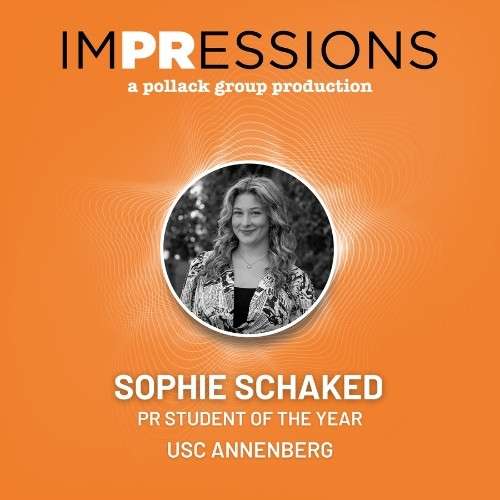
Graduation season is upon us, so what better time than to speak with PRWeek’s 2026 PR Student of the Year, Sophie Schaked? In this month’s bonus episode, Jenn and Brittany speak with one of the brightest PR minds of the future. Tune in to hear what Sophie’s generation believes will shift the PR industry and advice for those seeking a career in the field.
Transcript
Jenn
Hey, Britt.
Britt
Hey, Jenn.
Jenn
So, I want to ask you a question before we dive into today’s episode. How did you kind of get your start in PR? Did you have any internships or was there anything that was like very profound early on, maybe when you were a student, that made you sort of into the PR professional that you are today?
Britt
When I was a student, I actually, I started studying journalism, which I feel is a story many publicists will tell you. After seeing Almost Famous, I thought I was going to be a music journalist who got to travel with bands. And I did this great internship at a little place in Weehawken, New Jersey called the Syndicate. And at first, I was kind of writing articles and doing a lot of writing research for them. And there came a day where a couple of client emergencies came in and they were like, what do you know about PR? And I was like, well, I’ve taken a couple 101 classes. Like, I’m sure I can help. And it took maybe 4 hours, and I emailed my advisor over the summer. And I was like, when I come back, I’d like to switch my minors and my majors. I’m going to shift to PR. And that was it. That was the end. After that, I was just kind of immediately a strategy person ready to gently bully journalists to cover clients. And the rest is history. What about you? What got you like into PR? You know, what got you here?
Jenn
Oh, I was the worst. I changed my major like five times in college. I was all over the place. I wanted to be a physical therapist, and I did that for a while. Then I wanted to be a psychologist, and I studied that for a while. Then I went to studio art. I’m not good at art, so I don’t know what the hell I was thinking. I eventually, I had to pick something. I’m a junior now at this point in college, and I have to pick something to graduate. So I land on communications just because I was like, well, this is broad enough where I don’t really know what I want to do yet, but I, you know, I could kind of make this work, I think, whatever industry or whatever path I move forward on. And I ended up taking, same thing, I want to be a writer. I ended up taking journalist courses and it just kind of happened for me. I started in the music industry, as you know, and I ended up doing PR there because I did a little bit of everything. The company, I was their marketing manager, so I got to sort of dip into different things. I was doing event planning. I was doing social media and digital and things like that. And PR, when I started taking that over, I fell in love with it, and then decided to branch out into that on my own. So I, and I like these types of conversations because especially with PR, I feel like there really isn’t a linear path. So many people have gotten into this career in such different ways. And a lot of journalists, right, become PR professionals because they’re sick of I mean, journalism is really hard, especially in today’s world. So, they jump ship and come over to our side. And the reason why I’m asking you is because I’m excited about today’s guest because she’s very young and bright. And we usually have a lot of people who are pretty esteemed in their careers on the show. So, this is a little bit of a breath of fresh air. Sophie Schaked has just been named PR Student of the Year by PR Week, and she is also the latest recipient of the Noemi Pollack Scholarship at USC Annenberg. She has started her own branding and marketing company during the pandemic, okay, so like six years ago, and she’s a student now, so you could do the math. She’s into like nonprofit volunteers. She is really cool. And she’s going to talk to us a little bit today just about the next generation of PR, where her, somebody of her age and her stature in this industry and in her education sees where our field is headed.
Britt
And it’s always interesting to kind of see where students or those folks who are right in between graduating and what we’re going to call in quotes the “real world” think about the field. You know, they’re just getting out of these classrooms. They’re just learning the latest techniques. So, I think they always bring an interesting perspective to PR because it’s constantly adapting.
Jenn
It sure is. So, let’s see what she has to say. I think it’s going to be a great, a great episode.
Britt
Let’s do it.
Jenn
The future of PR is a bright one, and as Brittany and I navigate agency life here at the Pollack Group, we’ve seen a lot of transformation in our field and have had the pleasure of working with young and new talent. The next generation of PR is smart and ambitious, and we’re lucky to invite today’s guest. Sophie Schaked has been named PR Week’s PR Student of the Year, one of the most competitive and prestigious recognitions for emerging communications professionals. She’s also a recipient of the Noemi Pollack Scholarship at USC Annenberg; a program consistently ranked among the best in the world for public relations and communications. Today, we’ll uncover how she’s already putting theory into practice, launching her own branding and marketing company during the pandemic, getting involved in purpose-driven initiatives, and developing a perspective on communications that reflects where this industry is headed. Hi, Sophie. Thanks so much for being a guest today.
Sophie
Hi, thank you so, so much for having me. I’m beyond excited to be here.
Britt
First and foremost, Sophie, congratulations on being named PR Student of the Year by PR Week. That’s quite the accomplishment. Tell our listeners a little bit more about what this means to you and to your future in PR.
Sophie
Yeah, well, first of all, thank you so much. It’s the work that I put into it, no matter what happened, I was proud. So, what does this even mean to me? I think, in that moment when they announced my name, it just felt like a culmination of everything that I have been working towards. You know, in high school, I was on the news station and editor-in-chief of my newspaper and yearbook. So, it just felt like since that moment, I’ve been working towards something, and I feel like this was just the beginning. And I just, the words can’t come together of how proud I am to represent USC. It’s been my dream school since, you know, forever. As someone from Florida, it was like unprecedented that I even wanted to come to California. But I was here, and I had the pleasure of meeting Stefan and kind of all the pieces were put into place of my love for the public relations industry when I joined the Center for Public Relations. I learned more about what PR Week was and what it stood for. And working on this campaign, it just, again, felt like a giant puzzle that I had to piece together, which were the pieces of my life.
Jenn
How is the transition from Florida to California?
Sophie
My hair loves it significantly better because of the drier heat, but I miss my family a lot, but I love being in LA because it’s, in the heart of sports, culture, entertainment. So, I don’t, I’m going to school and taking my classes, but I still get to immerse myself in what LA has to offer. And I like work production assistant gigs on the weekend and take my friends to red carpet premieres. And to tell that to my friends back home, like almost puts them into a coma. It just feels like a dream every day.
Jenn
I bet. Well, I’m glad that you’re making a good time of your new transition over to LA. And one thing that I had mentioned in the introduction is that you’re also the recipient of the Noemi Pollack Scholarship at USC Annenberg. So, congratulations on that as well. Tell us a little bit about what that recognition has meant to you personally and professionally, because I’m sure there’s a lot of different emotions surrounding that. It’s a wonderful accomplishment.
Sophie
Thank you, thank you. No, yeah, I joined the Center for Public Relations my first year as an undergraduate, becoming, you know, the Center for Public Relations was a graduate-only research center. And so me joining, I became the first undergrad. And, you know, taking that step was first ambitious, and still applying to the Noemi Pollack Scholarship was a second step. And receiving that just kind of reaffirmed why I wanted to be in this industry. And for someone, who’s come from Orlando, Florida, who no one really knows, it was a chance on me and it was a chance on my future in this industry. I feel like Stefan and the Pollack Group were the first people to see and believe in my future. And for that, I am, endlessly grateful. And the continued support from Stefan and the group has just been kind of my backbone. And not only just a scholarship, but a group that I can rely on. And Stefan’s always there for, you know, advice or a coffee or a lunch for anything. And for me, it’s a relationship that I will keep for years because of the foundation it’s given me.
Britt
USC Annenberg also won the Outstanding Education Program of the Year Award. And as we all know, it’s widely considered one of the top PR programs in the world. You kind of spoke a little bit about your time there and relationships you’ve built, but what has been the most valuable lesson you’ve learned there so far?
Sophie
Yeah, I mean, that award, I was, I had to make someone hold my hand as they were announcing that. As much as I was nervous for my own award, doing it on behalf of your school is another thing. So that was incredible. But gosh, there’s so, many lessons. But I guess what our professors and my mentors have always taught us is don’t just do the PR work that you do in class, take that and go out and apply it. We are in Los Angeles, which is, we’re talking about media and PR, this is the heart and center of it, one of, sorry, New Yorkers. But, I just think they really tell us, as much as we’re in classes, writing our press releases, to share that with other people, whether it’s through coffee chats or internships, to apply ourselves as young professionals. So, the moment that we’re, you know, put out into the workplace, we have a full broad portfolio of what we’ve done and examples. And I think, you know, having that foundation from the very start, once you graduate, is beyond invaluable. And if we’re talking about valuable, I think that’s definitely the best. And the support network that our professors have given us to make ourselves as a PR professional, personal brand us, if you will, so that we go out and we differentiate ourselves in this crazy competitive landscape that is job applications.
Jenn
Yeah, I love that. And I think you kind of pretty much answered my next question, but I’m going to ask it just because a lot of our listeners are new in PR or want to go into PR, are in school or thinking about grad school. Are there any other experiences during your time at USC that you feel has prepared you for the real world PR and communications industry outside of what you just said, which is great insight, but is there anything else that you feel you’ve really taken away from your education that you can apply when you get your first real job in PR.
Sophie
Oh gosh, real job, that’s so scary. At the Center for Public Relations, which has really been my center, no pun intended, of my USC career, we do a lot of internal research projects, but companies externally will come and kind of use our center as a mini agency or a focus group or research group, so… I was asked my freshman year to join kind of the research group for Wasserman Music, or the team. For six months, our team and I did a competitive analysis, social media analysis, and hosted focus groups and did an entire PR campaign to rebrand Wasserman Music. They had acquired Paradigm Music two years prior, and they were a sports agency, and they were struggling internally on how to kind of put out to the world that they were there as a music agency, but most importantly, align with young professionals. Being in those meetings, using the language that they use, and then being at that last presentation in front of all of their C-suite executives was literally transformative. First of all, I realized how important the industry is to, you know, the business of the industry is to the music industry. But second of all, I realized how important PR research was and how much planning and detail and organization goes into it. I’m in a class right now where we’re learning a lot about PR research and how to do it, with intention. And it’s stuff that I’ve already put into practice. And that experience has realigned and reframed my desire and ambition in this industry to really do everything with intention and as much focus that we did. You know, not every project has six months to work on an incredible team like I had, but I think, you know, working together with a team to do the correct PR research, that has 100% shaped my experience. And, you know, when I created my campaign for PR Week Outstanding Student, I used a lot of that. I looked back at our presentation or thought process of, because these were grad students, they were so much older than me and it’s a lot of, the language that they use I put into practice today without even thinking of it. So, the bottom line is how that experience has shaped me is being able to articulate ideas correctly and with the correct data and analytics behind it.
Britt
You definitely have a unique perspective on PR because you represent the next generation that will be entering this field. What do you think your generation understands about communications that previous generations may have missed?
Sophie
Yeah, I think it’s important to note that Gen Z is not a monolith and that we, you know, we’re put into this group, but at the center we do a lot of research on how we’re consuming media. But I think we, because we have grown up, sitting in front of the TV, watching every Disney advertisement, and we were there at the boom of social media, we’re attuned to the trends. So, what we understand about communication is that we love kind of the communication that’s loud in our face. Think about pop-ups. We thrive off of FOMO. And the fact that we are not there, think about all the incredible, Coachella sponsorships that are about to pop up. To be able to put that into, whether it’s on social media or whatnot, I think what we understand is that it’s no longer siloed to just, you know, TV and advertisements. We’re ready to take it to the next level, to be on that forefront of what AI means in public relations. We’re ready to take that next kind of leap into the future, and we’re ready to lean into that, you know, unknown. So, we understand that, but we also understand a lot about diversity and diversity in audiences and diverse palettes. We’re seeing the rise of the niche community and the niche content creator. You know, the content creator who doesn’t, you know, has like 10 million followers doesn’t cut it anymore. because we want something to feel deeply personal and individualistic. So, we really understand on a subconscious level how to cater to everyone’s needs, because we’ve been hearing everyone’s opinions for so long because of social media, because of how we’ve communicated with everyone. So, I guess those are my two real big things.
Jenn
I think that’s great insight. And I want to pick your brain a little bit more about, you just mentioned AI specifically. Obviously, that’s a huge topic right now across all industries, but really, it’s very profound in PR and communications and journalism. You know, we’re still seeing movement with social media. How do you see the, new digital platforms and all of these kind of new things and evolving tactics within the communications realm? How do you see it shaping the future of public relations, especially for younger generations that are coming up through the times and, you know, are being born into a world where we have something like AI or social media? Like my time, not to age myself, but you know, the social media didn’t hit until I was in high school or, and that was like the birth of it. So, it really wasn’t until I was in college that it really became a full throttle thing. And then when I came into the workforce, did companies start utilizing social media in their marketing strategies? So, with generations and younger people that are born into it, how do you see, how do you see that shaping the future of our industry?
Sophie
Well, let me first say, you know, the people who think AI I will take over our jobs are absolutely crazy. I love the creative mind, and I hope and I know that will never die out and that can never be taken over by AI. So, let’s talk about it. AI, gosh. At Annenberg, they really encourage us to use it, hand in hand in our work. And of course, to cite it correctly and learning what that even meant. But also, I kind of use AI as my intern. I’m an intern right now, so I treat it like my intern. I treat it like my research kind of buddy to bounce ideas off of. I’m a creative person, so I like to collaborate and I can’t talk to a wall. With AI, I can just, even if it’s just like, yep, that’s great, keep going or dive deeper, I like that. So that’s how I use AI. I use it in gathering research for finding my sources, but never to write a full essay. I feel like, you know, what’s the fun in that? I’m here to learn. But also, I think it’s extremely beneficial. You know, programs like Brandwatch, which I use, which is a social listening platform to track social media sentiment and putting that into decks and conversations and to further create our PR campaigns that are more persuasive, and Meltwater, which is Microsoft’s, we’re beta testing for them. I think there’s incredible AI softwares. We’re using an AI software right now. It’s going to be so ingrained in our future. And I think with Gen Z, it’s using it as a crutch. And I want us to not use that. I want us to use it as our buddy, as our best friend, not as someone that we can constantly, rely on for every little thing to kind of see us swim when we need it, but push us further. So that’s how I see AI. I think it’ll completely change, you know, how research is done. You know, Grammarly, even if we don’t think it’s AI, it is AI. Using that, you know, do I use a comma here or do that? I think that’s pretty neat, but the future, gosh, I’m unsure, but I’m beyond excited to see how it is. I love doing everything manually, but I know this new generation is, you know, Gen Alpha, who is, AI is going to be their entire life. It’s going to be very interesting to see. And now social media, we are attuned. We are in it. I feel like social posts, everyone’s a content creator. We got that. But It’s hard to break through that. Someone, like Duolingo. Come on, it’s the common case study. Someone who broke the mold for their brand. And I feel like, you know, brands and comment sections and GIFs, and what does this mean if a brand is in a Discord chat with you? You know, what is that, you know, corporate courage when talking to your consumers? But I think social media is a great way to bridge new audiences together. Going back to Discord and Reddit, I think that’s where the future of social media lies into these niche communities and these brands kind of creating these moderated channels for fans to communicate with each other. With that, also live streams. You know, when I talked about FOMO, it’s this kind of, breaks down that barrier. You don’t have to be, you know, the fear, you’re there, right? Coachella’s this weekend, 5 zillion people are going to live stream. And I won’t feel FOMO because I’ll be right there with them. So, I think that’s something that we also understand, kind of the new emerging platforms. Vertical shorts are also an emerging platform that I’m excited to see, these serialized contents, because we like things quick, fast, and digestible, which is completely different than Gen Alpha who can sit down for 40 minutes for a 40 minute YouTube episode, which I don’t even think I can do that. So, it’s interesting how that’s changed. So, how AI, social media, and digital platforms are shaping the future of public relations. So, I think as public relations professionals, we can’t shy away of where everybody’s going to. And I think to really lean in and listen and kind of be those monitors to puncture the holes when we need to into the current zeitgeist.
Britt
We have talked a bit about, the future, but pivoting here to some other things you’ve worked on. During the pandemic, you started your own branding and marketing company, which is amazing. What did launching a business at such a young age teach you about communications and leadership and, you know, kind of what you wanted to do?
Sophie
I started this kind of as a passion project when COVID happened. I went to summer camp for, you know, since I was seven years old, and it’s in, you know, Maryland. And the only way I could communicate with my friends is through FaceTime or text. But I wanted something to show that we were all there together. So, I created this magazine on this small website called Canva, which we all know is like a giant corporation right now. And I’m so excited. But I was one of the first early adopters into, you know, what is everyone up to right now? And then I realized, wait; this doesn’t seem like work. This seems really fun. So, I just continued to start playing with it. And then I asked my mom if any of her friends needed help with graphics. Then I started going on our Facebook and pitching myself to people. creating, media decks, taking those PowerPoints and putting them into Canva and making them graphically, visually, and looking better, graphically better. There we go. But starting that business, first of all, doing something, taking that leap was incredible, but it taught me how to communicate. And again, personal brand myself. How do you trust, a 15-year-old with your social media tech? So, what I had to do was I started creating a portfolio, mock projects, so that I could show them. Showing them that, you know, you can trust the younger generation and I’m willing to work with you. So, I still do it a little bit today and it’s called Linus Designs because it’s my, amazing mane of hair and I created my own logo. But for communications, I created an e-mail and I learned how to e-mail professionally, how to talk on calls professionally, and again, have that, you know, personal branding for myself and leadership. I guess it comes back to pitching yourself, of trusting yourself when you’re a solo group; it’s a little hard. But when I started bouncing ideas off of my mom and my friends and the people that I were working with, it was significantly better. So that kind of created my foundation of, okay, if I can do this for other people, you know, what if we scale this? Then I found out what PR was. I go, oh, okay. This is exactly what I want to do. Because I don’t only have to graphically design it, I can then come up with the ideas. Because I found myself, reading these people’s, pitches for their decks, and I’m like, well, what if we do this? Well, what if we do that? And now I get to do that every day and still use a little bit of my Canva too.
Jenn
It’s incredibly impressive. And in addition to that, I believe that you’re also very involved in non-profit work. Can you talk to us a little bit about that as well?
Sophie
My passion for the music industry comes from being taken to concerts. Billy Joel and some of the greats at a very young age and realizing kind of the power of music. And although I’m not really in the music industry program here, I try to align myself the best. So, I helped produce a concert called a benefit concert for Altadena, a concert for Altadena. And I was asked to be put on this for the sponsorship side because I had an intrigue, a passion for creating sponsorships, but most importantly, I saw the devastation of the fires, and I couldn’t just sit there. I’m not connected to the Altadena community. I’m not connected to the Palisades community, but I couldn’t just do nothing. I had to do something. So, when this opportunity presented itself, I immediately jumped on it. So, for, you know, for half a year we worked on this incredible benefit concert for the community of Altadena because there was a little bit of frustration after fire aid of where’s the money going. So we were at the Pasadena Civic Center. We had an incredible lineup with Dawes and Friends, and we helped raise over half a million, and then we found out a few weeks ago that an anonymous donor matched that. So, we raised $1 million for the Altadena community, which was…
Jenn
Oh my God, that’s incredible. Congrats.
Sophie
Incredible. Thank you. It was, and I guess, you know, working on that kind of reframed my purpose in PR. That it doesn’t just have to be for these giant brands, you can help. And seeing it on such a small scale, watching these people come in, sharing their stories with me, it felt, oh my gosh, I think I cried so many times that night, but it’s real and it’s impactful. And the PR that we put into practice can absolutely change lives. And through the power of music and bringing people together, especially. So doing that nonprofit work, I want to do more. I want to do more. And because I’ve seen, I’ve seen the impact. And if I can do that right now, I want to continue doing that. So, it was January 7th. We had Dawes and Alec Black and Lord Heron and Brad Paisley. It was just phenomenal. It was phenomenal. And I was a small part of a larger, you know, group, but I loved every moment of it.
Britt
You have a super impressive list of accolades and accomplishments and kind of focusing and taking in all of that. For students who are listening and you want to enter the PR field, what advice would you give them?
Sophie
Oh gosh, I wouldn’t be lying if I had to look myself in the mirror and give my own advice because I’m also entering the industry. But I guess my biggest piece of advice is do not be afraid to go out there and brand yourself and be the change that you want to see in the world. I’m beyond interested by the fan journey and how brands can intercept that fan journey, you know, before, during, or after an event or a campaign happens. And so, it’s been my mission to kind of uncover what exactly this means. So, I’ve now branded myself as the live events fan girl and not siloed in that because there’s so many different things, but finding your niche, finding what you add to this industry kind of reframes and redirects your entire narrative. So, find the thing that’s motivating you, your why. And I know that’s why everybody has told me that, but once it clicked for me, I understood. that’s what I want to do because, at the concert for Altadena and at, these, conventions and events that I produce, I get to peek from behind the curtain, and I get to see real lives being changed. And that’s my why. You know, if we as PR professionals can just take for 5 minutes someone’s mind off of whatever they’re doing or their hardships in their life and just smile, I think that’s what we can, that’s all we can do as PR professionals, create real change for one to one million people. I think that’s my why. So young professionals just like me who are navigating the industry, find your center, find your core, and then you can go out and make real change. Because, you know, I think that’s incredibly important.
Britt
That’s really thoughtful.
Jenn
Yeah. I completely agree with that. And I think it was very beautifully said. In addition to that, for our listeners, just to kind of end here, is there anything, any habits or mindsets? And I like to ask a lot of our guests this question because everybody has a different answer. Is there anything, any habit that you do daily or any type of way of thinking that has helped you succeed so early in your career? You’ve really made so many incredible achievements. So, is there anything that people can learn from that you do in your daily life, in your everyday world that some people can sort of take away from this conversation?
Sophie
Yeah. At my heart, I’m a journalist. So, every morning before scrolling on TikTok, because I think that’s a form of media training, I read the news. I subscribed to, you know, Axios, New York, LA both times, the Post, and at USC we have free subscriptions, PR week, and I just read. I get the updates every morning and I make myself aware of what’s going on in the world. And then I test myself during the day, which doesn’t really always happen, but I try to put at least one of those news headlines into conversation. I am a firm believer in you learn by teaching. Like I have to be someone who tells someone about a subject. I’m like, oh, okay, right. That does make sense. So, I like to put that into conversation and continuously putting those topics into conversation. And then I scroll on TikTok and I see what the people, what everyone is talking about. What’s the new trend? What’s the new fad? And I think scrolling on social media is important to our work because we need to be within those trends. So that’s what I do. I try to educate myself every morning and then put those into conversation. Sometimes it works, sometimes it doesn’t work, but I get to go to class every day. So, we always open up a forum of what’s going on in the PR industry, what’s going on in the sports industry, depending on what class I’m taking. And I try to chip in. I try to add to the conversation. So that’s my habit. I try. I hope I never break that habit because it really keeps me informed and keeps me going.
Jenn
I love that. And this whole conversation has really been insightful. I think what you’ve really nailed is that what stands out the most about this next generation isn’t really waiting for permission. You’re building, you’re experimenting, and many students like you are leading with purpose in a way that’s really pushing the industry forward. So, Sophie, congratulations again on being named PR Week’s PR Student of the Year. It’s obviously incredibly well-deserved, and we can’t wait to see everything you do next.
Sophie
Thank you. You know what? Thank you to the Pollack Group. Thank you to Stefan. You guys are absolutely fantastic.
Britt
Thank you, Sophie.
Jenn
Yes, thank you. And this has been a pleasure. And to our listeners, whether you’re just starting out or you’ve been in this industry for years, there’s something really meaningful to take away from this conversation. So, stay curious, stay adaptable, and don’t be afraid to create your own opportunities. So, keep listening to our show for more insights and advice, and we will see you all next time.