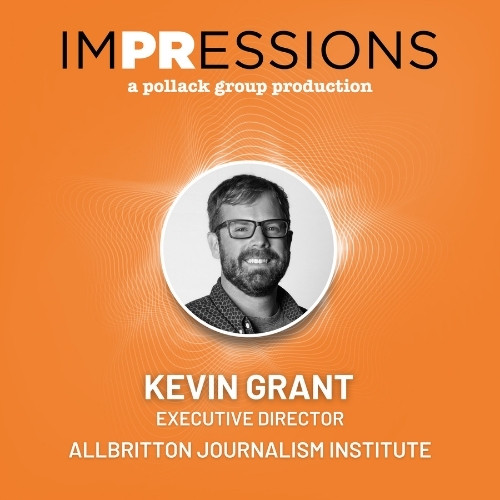
Political reporting dominates our social feeds and increasingly influences the way brands communicate. It’s a critical component of journalism and is more than just what’s happening in Washington, D.C. Policy stories are all around us – in our local media and affect businesses and societies on a personal level. Today’s imPRessions guest is Kevin Grant, executive director of the All-Britton Journalism Institute, who shares insight into how reporters are connecting national political developments to local audiences and how media consumption habits are reshaping the news cycle.
Transcript
Jenn
Hey Brittany.
Britt
Hey, Jenn.
Jenn
Welcome to imPRessions.
Britt
Great to be here.
Jenn
So, you are now going to be co-host of the show, which is very exciting. Do you want to say a couple of things about yourself to our listeners before we talk about today’s guest?
Britt
Absolutely. I’m an account supervisor here at the Pollack Group, specializing in all things PR. I reside in Queens, New York, which is where I was born and raised, and I’m a die-hard New York Mets fan. Super excited to be a part of imPRessions and looking forward to all of the great guests we’re going to interview together.
Jenn
Look at a Mets fan and a Yankees fan coexisting in peace.
Britt
True harmony.
Jenn
Well, I’m really, really excited that you’re going to be co-hosting the show. And I think today’s guest will be a great introduction for you. We are welcoming Kevin Grant, who is the executive director at the Allbritton Journalism Institute. We’re going to be talking about political reporting today, baby.
Britt
Some of the most important reporting going on in today’s world.
Jenn
100%. So, we got questions about what he does at the Institute, political reporting just in general for people that are curious as to how this part of journalism works, because it’s very tricky, I will say, to put it lightly.
Britt
Great. Let’s dive on in.
Jenn
Political reporting is everywhere. It’s on our social media timelines and widespread across national publications and broadcast stations. In fact, most people correlate political reporting with breaking news alerts out of Washington, DC. But political journalism is so much more. Today’s guest, Kevin Grant, executive director at the Allbritton Journalism Institute, is at the center of a new model for political reporting. One that’s focused less on telling audiences what happened and more on explaining why Washington works the way it does, and how national power translates into local impact. Today, we’re unpacking what this new age of political reporting really looks like, how national policy becomes local news, where traditional coverage falls short, and what communicators, brands, and organizations need to understand if they want to break through in an increasingly skeptical media environment. Hi, Kevin, thank you for joining us today.
Kevin
Hi, thank you so much for having me.
Britt
Kevin, when people hear political reporting, they often think national headlines. In your opinion, how is political reporting changing right now? And why does it matter more than ever at the local level?
Kevin
Yeah, you know, I think that political reporting is sometimes just contributing to the cacophony in the United States today. There is so much noise. And I think typically a lot of the political sort of information, political journalism, that Americans are getting is in the form of punditry. So, something that’s been really important to us at Allbritton Journalism Institute and at NOTUS is to focus not just on why decisions are made in Washington and how, but how do those decisions affect local people? And what we are seeing is that there’s still a huge market for this type of coverage, for this type of reporting that connects political reporting at the national level to the local level, really filling a gap so that people can make better decisions for themselves, for their families, for their communities.
Jenn
And we are certainly in a timeline in our country where political reporting is more important than ever, to put it mildly. And you just touched on NOTUS. So, I want to talk a little bit more about that. And as I mentioned in the introduction, NOTUS focuses less on what happened and more why Washington operates the way it does. Can you talk to us a little bit more about that and help us understand why framing it the way that you have was so important to build into the newsroom?
Kevin
Absolutely. So, you know, it’s important to our reporters and to our whole team that we take readers and viewers and listeners behind the scenes. So, that means definitely getting an understanding of the sort of procedure and process that Congress might use or the interplay between congressional leaders and the White House. But we also want to go a level deeper and help understand the role of lobbyists, for example, political contributions, different social and political movements in shaping some of the decisions that are being made here. And then certainly also the relationships that elected and unelected officials have with people back home and how the different sort of needs and the different interests in different parts of the country are either overrepresented, underrepresented, or about even, and trying to give sort of a mapping in the different types of coverage that we do about those relatively complex interplays while keeping the stories simple enough that they’re digestible, that somebody can pop into our newsletter, give it a pretty quick skim, and feel like they’re getting a handle on the most important things that are happening in Washington each day.
Jenn
And what kind of, what started this? Because this is a really interesting and unique take on political reporting. Can you just tell us a little bit about what inspired this to, you know, how you started this, how your team, you know, got this rolling? Because I think it’s really important for our listeners to know its inception.
Kevin
Thanks so much. This goes back; AJI was founded in 2023. Robert Allbritton, who had founded Politico, sold the publication. He had some resources as a result of that sale that he knew that he wanted to put back into journalism in an idealistic way. So, at AJI, we say that democracy needs a new generation of journalists. And AJI really is a journalism school. It’s a next generation educational institution that really later in 2023 and then fully in early 2024, launched NOTUS as not just what has become a leading publication in Washington, but also as a teaching hospital, as a place where our full-time reporting fellows can work day-to-day alongside more experienced reporters and certainly editors who make this whole thing happen. And what we found is that there’s a real idealism across the organization, that there’s a strong spirit of collaboration, that journalists tend to get into this work for a lot of the same reasons. They want to make a difference. They want to help educate the public. They want to hold leaders accountable. And so, we embrace all that. We lean into it. And at the same time, we recognize that, say, the DC Press Corps is not always super welcoming, super inclusive. It doesn’t necessarily represent the country very well. So, what we do is we actively recruit emerging journalists from a lot of different backgrounds. And we encourage them to bring their life experiences, their sort of understanding of the world, their relationships with different types of sources or communities, but certainly not their opinions. So, we take a very traditional view of a nonpartisan, no-nonsense, straight-ahead type of reporting and writing and communicating across our platforms. And at the same time, we say that we get stories that other people don’t because we hire candidates and reporters that other organizations don’t..
Britt
You’ve covered a little bit of this, telling us about the mission behind AJI, but we’d love to hear more about how NOTUS fits into the bigger vision of training the next generation of journalists.
Kevin
Absolutely, yes. So, NOTUS is almost an incubator in certain ways. Certainly, reporting out stories, many times a day, we’ve got, lots of different coverage that’s going out in all kinds of ways. But also, it’s a place where, just over the last few months, we’ve launched the NOTUS podcast where Reese Gorman, one of our NOTUS reporters, interviews different members of Congress and tries to go a couple levels deeper, like I was saying before, to understand what makes them tick, how they think about their own decisions, their sort of role in Congress, their role in Washington. And we have lots of conversations both within the newsroom and in the classroom down the hall about how journalists can approach these types of conversations, how to conduct an interview in a nuanced way, how to be well prepared, how to maintain relationships even when sources aren’t happy. So, there’s a lot of learning by doing. And again, whereas, and I’ve done a lot of work in supporting next-gen journalists in local newsrooms, now, a large national newsroom, I’ve worked with lots of international journalists. Something that can sometimes happen is that reporters, especially those who are early in their careers, are just expected to figure it out. And if they don’t know something, they may very well be discouraged from asking. They may be really uncomfortable sort of branching out to try to get better. Here, it’s the opposite. Here it’s, if you’ve got a question, just ask. If you’d like to sort of look over the shoulder of a more senior reporter, if you’d like to co-byline a story, there are so many opportunities to get better each day. And we’ve had a lot of goodwill from other leading outlets from the Wall Street Journal and Washington Post to Associated Press and others; they really appreciate the model. They like how we approach our journalism, and many of their sort of leading journalists actually spend some time in our classroom helping our reporters get better too. So, we’re definitely part of a larger ecosystem. We want to give back to that ecosystem just as we’re receiving from it.
Jenn
I love this concept. I mean, I almost kind of wish we had something similar like this in PR, because to your point, it’s the same thing in our industry as well, where you kind of learn as you just go, right? You’re thrown in kind of immediately, you know, at least in my career, Brittany probably as well, you know, you start out and it’s like, okay, you’re part of an agency now hit the ground running. And I just love the fact that you’re bringing on individuals who are new in their careers and pairing them with veteran journalists so that they really understand the landscape. And I think that’s just really cool of you guys to do that, especially, like I said, political reporting is so important, and it needs to be done correctly. So, as you’re the executive director, can you tell us a little bit about how you run the newsroom and like, how do you, how do you know to pair certain journalists, you know, early career journalists with veterans? What does like kind of the day-to-day look like? I’m really interested to know how that works.
Kevin
So, this is actually a cool part about how AJI and NOTUS work together. So as executive director of AJI, I’m overseeing our school, our educational and programmatic partnerships. I’m working very closely with the NOTUS editorial team who are setting the news agenda each day, who are taking the lead in building new products out of the newsroom. The fellows that AJI recruits and brings into the classroom, brings into our organization they work in a symbiotic way, in the sense that they are in the newsroom and on Capitol Hill and covering a variety of stories. And at the same time, they’re spending time here in the classroom. And we’re regularly having these kinds of conversations across this team. about, what makes NOTUS unique? What makes for a great NOTUS story? Who should we be hearing from right now somewhere in our field who has some particular insight or expertise about a certain type of story that one or more of our fellows is going after? So, you know, it’s this living laboratory, this sort of ongoing collaborative network. And while we each have our different roles to play and we each have our different jobs, of course, we try to keep a really high level of understanding among us so that while, for example, I don’t have an editorial role, I do come from a journalism background, but even though I’m not making decisions day-to-day on what stories NOTUS is going to cover, I’m very well aware of NOTUS’s sort of day-to-day and week-to-week approach to coverage. And so we, as educators, can help to prepare our reporters in real time, sort of fill knowledge gaps, and also provide, almost real-time skills if they’ve got to tackle a big sort of data-related assignment, or, like I mentioned, if we, start to think about expanding our podcast opportunities, or, we often have reporters, appear on some of the leading news channels or certainly on podcasts like this one, they’re regularly getting picked up in a variety of other outlets, and they are frequently invited to events. So one of the things we can also provide to these next-gen reporters is media training and really just helping them get ready for these types of opportunities, boost their confidence, help them get out there, which then, of course, helps them to land their next jobs when the time comes.
Britt
You’ve spoken about those gaps there. You kind of just touched on it. And we know in 2025, NOTUS launched the Washington Bureau Initiative. Tell us a bit more about that and what gaps you recognized in political coverage that made that partnership with local newsrooms necessary.
Kevin
Yes, thank you for asking. This is something that I’ve been particularly passionate about. It’s one of the first things that I worked on when I was hired by AJI was to start to canvas local newsrooms across the country about their potential interest in working with NOTUS on essentially trusting NOTUS to be their Washington Bureau at a time when very few local newsrooms have the resources to have a full-time reporter in D.C. So, you know, we had a bunch of conversations. We immediately heard that overwhelmingly local news outlets would… really wanted this kind of service. We learned a lot about what maybe the ideal configuration would be for editors in both newsrooms. And we’re currently now in, we’re in 12 states and rising. And we learned that, you know, if editors can actually just be together in a Slack channel, if they can be talking regularly, jump on a Google Meet or whatever the case may be, get a sense of what the sort of news agenda for the week ahead may be. If there’s a particular story that somebody in the NOTUS newsroom can be chasing that is going to be particularly relevant to a local audience, that’s fantastic. Or if there’s a local source who can contribute to more of a national story that NOTUS reporters are chasing, that’s wonderful as well. So, we just essentially, it sounds a bit cheesy, but we realized we could be stronger together, that we needed to be sort of responsive to one another’s editorial needs. and that we could also share the cost of, day-to-day having reporters at NOTUS, cover these locally relevant stories, that local newsrooms would be willing to contribute financially to the partnership and in return would have access to a wide range of NOTUS work, the sort of tailored coverage that we did with our partner in mind, and then also a wider sweep of coverage that editors at our partner newsrooms are finding is of value. So, we’re finding this is really robust. We’ve now published hundreds and hundreds of stories. I don’t think we’re quite at 1000 yet, but we’re climbing toward 1000 stories published in our first year of existence. And actually, just now, February, late February, is our one-year anniversary of launching the Washington Bureau Initiative.
Jenn
Well, congrats. That’s amazing.
Kevin
Thank you.
Jenn
And, you know, there’s certainly a need for it. And there’s certainly a passion in you, right, in just talking about, you know, bringing this to life. I want to switch gears a little bit and ask one of the most obvious questions, right, as, you know, us as Americans. A lot of us are very disconnected from local reporting these days, even though it affects our daily lives, very much so. Why do you think that is? Why do you think that we’re just so disconnected and so turned off and out of tune with what’s happening in our country?
Kevin
Yeah, I think it’s a great question. And I think a lot of it has to do with the fact that it’s become a fire hose of sorts. I mean, of course, the way that so many of us get our news now is through kind of almost a hodgepodge of social media and newsletters and texts from friends and family. Some of us still take a newspaper or two or are loyal enough to a particular news brand that we’ll actually go and check their website every day. But I think a lot of us are just like catch as catch can. It’s a lot at any given moment. Maybe we also even are signed up for alerts on our phones from particular brands that we trust. But I think all in all, there is a sense of it’s basically too much information; much of it feels greatly removed. I think a lot of us feel, and I’ve seen some research to this effect, that basically news is overwhelmingly negative, and most of us feel like there’s not a whole lot we can do with the news anyway. So, it’s sort of this compound problem, right? Way too much information. It’s bumming me out. I can’t do a lot about what I’m learning anyway. And so now what? So, you know, yes, like part of our approach that differentiates us is the local angle and trying to demonstrate and show to audiences, okay, this actually matters here. If a DOGE budget cut is going to shut down the nuclear safety facility in my community that not only provides local jobs, but is also keeping the state and arguably the world safer through its safety protocols, that’s something that immediately, and this is a true story, this was a NOTUS reporter Anna Kramer who broke this story in New Mexico. And it actually did spring a whole bunch of people into action who said, like, this can’t happen. And so local officials started to get activated and realized that they needed to take some action. And ultimately, this facility was allowed to remain open. And these are the kinds of accountability stories that we also focus on. So, it’s definitely locally relevant, but also a sense that the press still has a really important role to play as a watchdog. And if we are doing our jobs and staying on top of the types of stories that affect real people and we sort of show how we approach our work, we’re super just transparent and candid about our process without bringing any political bias into the work, we think there’s a level of trust that can be established there. Like I mentioned before, the newsletter, just a pretty simple way to keep up. We’ve been hearing increasingly across the sort of Beltway audience, but also nationwide, we now get notes all the time that just say like, thank you, NOTUS, you know, this is like a very sane way for me to get my political news each morning just by subscribing to your daily newsletter. And then I feel like I don’t necessarily need a whole lot more. So, I think also if we can serve sort of a core group of people that way, that’s another way so that they don’t need to feel like they’re just wading through the mire at any given moment.
Britt
You just kind of brought up how, people are kind of newsed out, if you will. You’re hearing, quote, bad end quote things from all over the place. Do you think this local pull or angle with news makes it a little bit more digestible for people to kind of see themselves in it?
Kevin
I think that’s right. I do think that’s right. And, you know, what we’ve found is our local partners have been really smart about framing the work that we’re doing together and the reporting that we’re sort of doing on behalf of the partnership. They’re framing it to their audiences, explaining what this partnership is, why they entered into it, the kinds of insights that they are trying to provide. They’re often including particular NOTUS stories within their newsletters. We have a couple different editors who write columns for their publications. I’m thinking of Ted Struly at Oklahoma Watch as just one example. And he regularly sort of talks through and adds context for some of the work we’re doing together, including, for example, various stories. Again, I feel like funding is a big theme of today’s conversation, but funding cuts to different indigenous communities across Oklahoma, which Oklahoma Watch has been on top of for a long time, predating our partnership, but we’ve been able to bring some new depth to some of those stories. So, personalizing, definitely, people knowing that there is actually someone or a team of journalists who are watching out sort of on behalf of that community. That seems to be another nice way to help the information land. I think, and I think there’s more data to collect here, but it also makes that information more shareable when you have the sense like, oh, yeah, I think I can trust this. Oh, it actually sort of feels like this journalism was made for me. I think I’m going to share this with my family or I’m going to share this with friends. And it doesn’t always have to be sort of news that angers, although there’s plenty to be angry about. Sometimes it’s just, hey, this is something to sort of keep on our radar. We don’t know quite how this decision is going to play out or how Congress will vote or what the Supreme Court vote is going to mean. But here’s something to stay on top of. And as an audience member, as a member of a community, I can trust that the editor who leads my local publication, or even the partner in Washington who has been pretty well explained and introduced by people they trust, all those folks are going to let me know when something really is significant so that I don’t have to try to keep on top of it every day.
Britt
Continuing to kind of pull at that local news thread here, from your perspective, Kevin, what kinds of national policy stories are most often misunderstood or under-covered by local media?
Kevin
Wow, yeah. You know, I think there’s probably no national policy story that wouldn’t benefit from a collaboration between DC-based journalists and local journalists. I say this in part because there are certain types of sourcing that’s just so much easier to get when we are here. AJI fellows, slash NOTUS reporters are on Capitol Hill every day. And so, they can regularly, ask a question that a local audience member, a local community member may have. Ask that question as, you know, they’re passing so-and-so member of Congress in the hallway, you know, put that into a story and then ship that back for a couple of publications. So, we can add more sort of nuance around immigration stories or health care or education. We’re basically finding that any major policy story has massive potential to be misunderstood. And a lot of that is, of course, everything is politicized. We know that. But also, a lot of times the information that people are getting is really just the messaging of political candidates or political office holders. What they’re often then not getting is just the matter-of-fact reporting that includes the context for how these decisions are happening. And I mean, to maybe state the obvious, but just to almost a throwback at this point, just to be grounded in facts and have the facts of the matter be high in the story or high in the conversation, you know, that too, I think, contributes to more nuanced dialogues. And I’ll just say this, this, maybe just as an example, is now increasingly common that our local partners all over the country, and it’s not just this is not exclusive to AJI and NOTUS partners, but increasingly sort of next generation local newsrooms are having really nuanced conversations about these types of policy issues by hosting events in their communities. So, they’re actually inviting local leaders from different backgrounds. They’re inviting journalists. They’re inviting different types of stakeholders to say, hey, we understand this is a lot to keep track of. This is super complicated. Why don’t we all meet at the library or at the cafe or, you know, somewhere nice, somewhere pleasant. And let’s talk all this through. And everybody can feel like they’re getting smarter. People can ask questions. They can make comments. And as long as we’re staying, you know, relatively civil, not that people can’t, you know, get a bit heated where it’s, you know, where they feel passionate, but just that we can all have a sort of shared civic experience. And that can be informed by journalism. But I think it’s also important to note that journalism can’t be the end all be all. It’s not a substitute for that full civic experience, which often includes dialogue among community members.
Jenn
Yeah, that’s a great point. And something that you brought up, a couple of great things that you brought up a few questions ago in just talking about why people feel disconnected. And one thing that stuck with me is, A, there’s a ton of information, and it’s really overwhelming for us to really keep tabs on everything that’s happening at any given moment. And also, it is negative. And with that, and you touched on this a little bit already, is with journalism, there needs to be trust. And in some cases, the general public hasn’t had a lot of trust in some of the ways in which reporters are covering stories or providing accurate factual information. So, in your role and what maybe Allbritton is doing and what NOTUS and everybody on your team, how do you build trust again with audiences who are skeptical of political coverage?
Kevin
Totally. Yeah, great question. So, I think what we’re seeing is that the more that you can show your face and the more that people can hear your voice, right, the more that they begin to trust what you’re saying. So, I think that’s why we’re seeing not just in traditional media, in digital media slash journalism, but also in this sort of rising, you know, influencer space, the sort of the rise of the creator journalist. I think there are a lot of different types of information providers that are all arriving at the same conclusion. Like, I’d better create opportunities for people to really hear from me and to have more of a dialogue. And of course, the internet’s been making that more and more possible. There’s a flip side to that, which can be incredibly toxic. And sometimes people come into the dialogue just to say terrible things. But, you know, I’m thinking of maybe two different specific ways that, you know, journalists who are out in front and making this direct contact through podcasts and through, different types of social media offerings as well. I think one is to just be super earnest, candid, show your work, try to provide information that maybe is being lost or underplayed by traditional or, just sort of, legacy media. That’s one way just to say, hey, I’m giving you stuff that you’re not going to get elsewhere. Of course, that can drift into conspiracy theory. We can get pretty deep down some rabbit holes. And yet, you know, if you’re showing your work and you’re providing research and sort of talking about how you’re arriving at the stories you’re telling, I think that there’s a lot of credibility in that. And then I think on the flip side, maybe a lot less serious, is just remembering that we’re all people. And so, a sense of humor, some lightheartedness, some vulnerability, when a journalist or even an influencer or creator who’s taking more of a journalistic approach, if they’ve got a personal connection to a story, just talking about that. That can work really well. And I’ve been reading actually some great pieces about the big losses at the Washington Post, the big cuts. And there are so many folks certainly here in Washington who grew up reading the newspaper, right? That’s like actually the way that they like started to learn to read. And that’s like some of the early conversations they were having at the dinner table were about Washington Post stories. So, what I’ve been seeing a lot of that seems to really resonate is, talking through your personal connection to this publication and then getting into maybe some analysis about what’s going on, why are these cuts happening, what’s the future of the post, and so on. It seems like that personal connection goes a long way to building trust as well.
Britt
We have discussed a lot the journalist side of this, but for our PR and communications professionals who are tuning in, what is the biggest mistake you see brands or organizations or advocacy groups making when pitching political or policy adjacent stories?
Kevin
Yeah, I would just, I would say it this way. We talk so much about how journalism is about people. And I think it’s just the exact same thing when it comes to public relations professionals, working with journalists. It’s about people. So thus, it’s about relationships. And I think this goes both ways, right? It’s about the best practices that we know work in journalism when it comes to building sources is to be clear, to be polite, to show respect, to follow ethical norms. You know, if you are receiving a pitch and it’s time sensitive, you know, being clear as soon as you possibly know on whether you’re going to take the pitch or not. You know, if you are repeatedly sort of being reached out to by somebody who’s offering you good information, at the very least, taking the time to say, I really appreciate the fact that you’ve been getting in touch, and I’m sorry that I haven’t been super responsive, but, you know, please keep this information coming and, would love to, see if something’s going to make sense down the road. Just managing those relationships, not looking past what are, often terrific sources of information. And like I say, just, going out of your way to be clear and ethical and as transparent as you can be about if you’re talking through a potential story and you’ve got to run it by your editor or whatever the case may be. that you’re just giving, your colleague at an agency, for example, a heads up about where things stand. So, nobody feels like they have to hound each other. So maybe the biggest mistake then is just, on the journalism side is maybe journalists looking past their colleagues in public relations. And on the flip side, there may be a sense sometimes if, a journalist’s inbox is like overwhelmingly full and just insanely, it’s a big news day and there’s just insanely too much to handle, maybe just giving that grace and, avoiding sort of asking too much. I know it’s not maybe the most insightful answer, but we’ve just found like, because we preach it so often that if you’re building an amazing network of colleagues across different fields, across different industries, odds are that that’s going to be valuable down the road. It’s going to end up turning into a story or a series of stories that will mean something. And so, you know, therefore, best not to burn any bridges and best not to, I guess, get bummed out if it feels like you’re putting in a fair amount of energy and nothing’s clicking yet.
Jenn
There’s a lot. There’s a lot that we covered. There’s a lot to understand and impact, just unpack in today’s government. Kevin, this conversation was really important to us. I especially have wanted to talk about political reporting on our show for a long time, especially, you know, Brittany and I as PR professionals, really wanting to understand the nuances of local and national coverage. And you did just that. So, thank you so much for being a guest and walking us through this really important topic. It was great, and we really appreciate your time today.
Kevin
Oh, it’s my absolute pleasure. Thank you both so much for having me on. I loved our conversation.
Brittany
Thank you, Kevin. It was a pleasure.
Jenn
Yes, and thank you so much to our listeners for tuning in. Please follow us on The Pollack Group’s social media channels and tune in next time for more conversations on the world of PR and marketing. Until next time.