
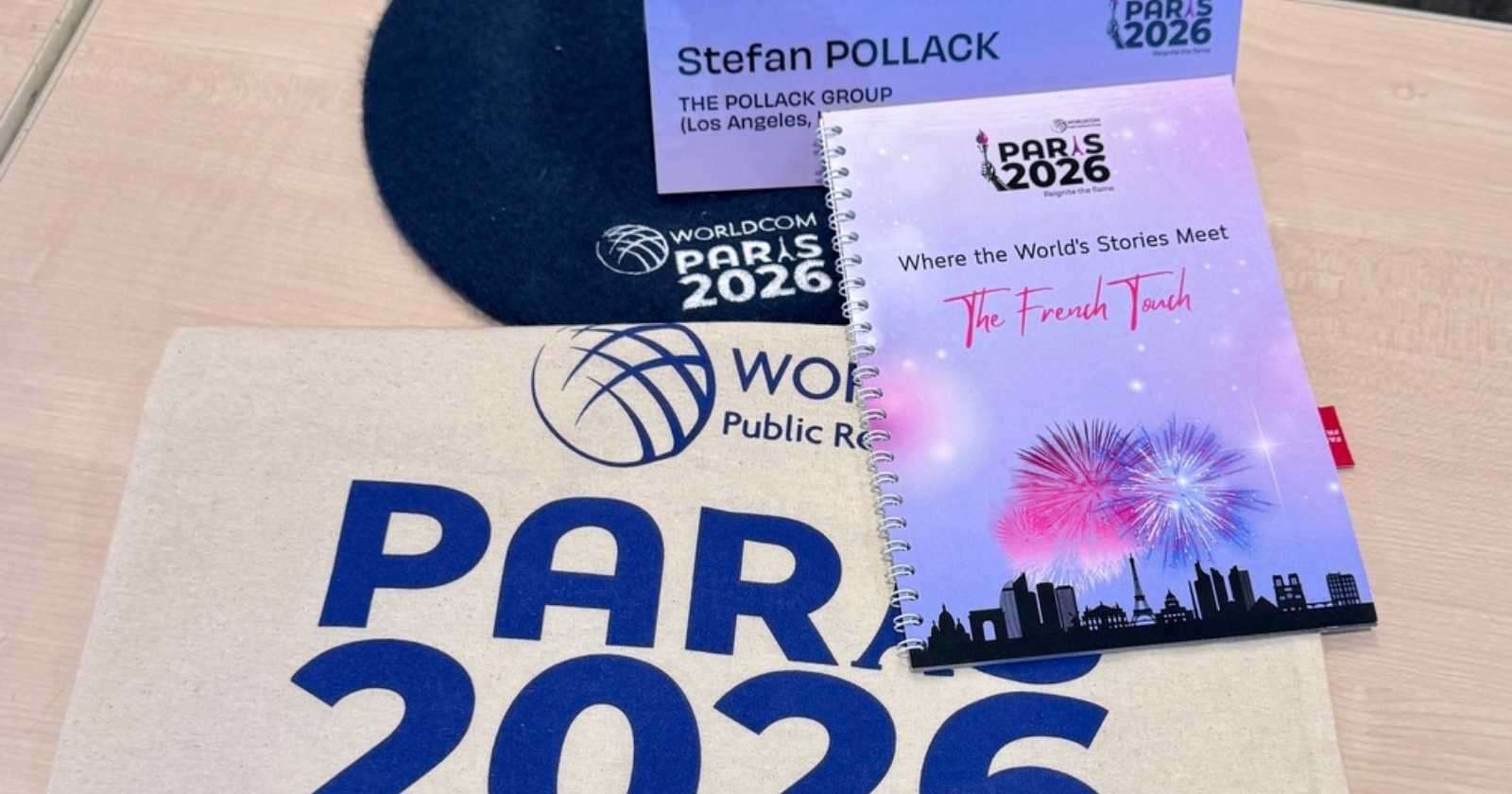
The most important conversation happening in communications right now isn’t about AI. It’s about whether anyone actually believes you anymore.
That was the thread running through the Worldcom Public Relations Group’s Annual Global Meeting in Paris, where agency leaders from 94 independent agencies across four regions spent four days confronting a hard truth: as tools get smarter and content gets cheaper, trust is eroding beneath it all. Today, what you say about your brand and what is said about your brand matters less than whether anyone believes the source behind it. That’s not a technology problem. It’s a strategy problem. And it’s one of the most significant that brands significantly underestimate.
The Permacrisis Isn’t Coming. It’s Already Your Operating Environment.
The title of one of the AGM’s opening sessions said it plainly: “The Opportunity Within Instability: New Models for Crisis Communication in a Global Permacrisis.” It wasn’t framed as a warning. It was framed as a business reality, and the discussions that followed treated it as such.
Across every market, the pattern is clear. Brands are no longer cycling in and out of crisis mode. They are operating in a constant state of ambient risk, where reputational threats can emerge from any direction. Whether it is regulatory, cultural, competitive, or algorithmic, often a reputation crisis can emerge with little warning and even less time to respond.
The difference between brands that weather these moments and those that are defined by them is not messaging; it’s infrastructure. The organizations navigating this landscape have already put in the work by auditing vulnerabilities, aligning leadership voices, and building decision frameworks. These crisis management tools allow them to act without hesitation when the unexpected happens.
That is exactly why we designed CrisisGuard 365 as an always-on function, not a reactive service. In a permacrisis world, the real value of crisis preparedness lies in the groundwork laid long before any incident occurs.
The conversations in Paris echoed what we have seen over decades: the brands that emerge from crises intact are those that treat preparedness as a continuous strategic investment, not an annual checkbox.
The AI Conversation Nobody Wants to Have Publicly
The Thursday morning session opened with a provocation: in 2025, AI-generated content surpassed human-created content online. Clément Bascoulergue of Integral Ad Science framed the challenge with precision. It isn’t that AI is bad for brands. It is a revolutionary technology that enables marketers. However, it is also powering the low-quality, fraudulent, and unsavory environments that brand marketing dollars end up funding. AI Slop. Made-for-Arbitrage sites. Deepfakes. The infrastructure of brand erosion is being built with the same tools as the infrastructure of brand growth.
Here’s the conversation that nobody in our industry wants to have publicly: the same tools we’re using to scale content are accelerating the credibility crisis we’re hired to solve.
According to Bascoulergue, audiences are no longer just skeptical of misinformation; they are now skeptical of sheer volume. The more content a brand pushes out, the more scrutiny it invites. This reality flips the traditional content marketing logic that has shaped most digital strategies.
The agencies leading today are not producing more content. They are producing content with a sharper point of view, delivered through sources their audiences already trust. Brand authority is shifting from a reputation goal to a distribution strategy.
This shift changes how communications must be built from the ground up. Message clarity is no longer just a copywriting task; it is a strategic imperative. When messages are stripped of context, shared out of order, and judged by audiences who never asked for them, every word matters more than brands realize. That is why the foundation of effective communication, what we call Message DNA, has only grown in importance as AI fills every channel with content that sounds credible but says nothing.
How Agencies Are Actually Using AI: A Real Answer
Worldcom PR Group’s Thursday afternoon session invited agency partners to share concrete AI use cases, not aspirational ones. It was one of the most useful hours of the week precisely because it dispensed with the usual abstract debate and got specific.
One platform I presented is a new company we soft-launched in Paris with my co-founder Erik Deutsch: SmartFocus.ai. It is a purpose-built tool for running AI-powered focus groups that deliver research-grade insights in hours rather than weeks. It’s not a chatbot repurposed for market research. It was built from the ground up for the kind of work agencies and in-house communications teams need to do:
- testing messaging before it’s public,
- stress-testing crisis responses before they’re deployed,
- pressure-testing campaign concepts before the budget is spent.
The practical value is significant. SmartFocus creates scenario-aware personas calibrated for your specific session and today’s cultural contexts, not generic archetypes. Focus groups can be revisited and refined as the strategy evolves. And the output is a structured report with actionable takeaways, not a raw transcript that requires another week to interpret.
For communicators operating in an environment where speed, message precision, and audience intelligence are critical, this kind of tool is a true operational advantage, not a novelty. It is the difference between launching a campaign and knowing in advance how it will land.
When 37% of PR professionals in the 2026 USC Annenberg Global Communication Report identifies ‘testing messages with synthetic audiences’ as a high-impact action for the next five years, it is clear the industry sees the direction of travel. The agencies that move first will gain a measurable edge.
Gen Z Isn’t Hard to Reach. They’re Hard to Fool.
Friday morning’s session, “Gen Z, Fake News & PR: Navigating Trust in the Age of AI,” brought in Gen Z voices directly, and the conversation was clarifying in the way that only unfiltered perspectives can be.
A lot of agencies are thinking about Gen Z, still framing them as a media consumption puzzle, which platforms, which formats, which influencers. That framing is increasingly obsolete.
For Gen Z, the relationship with brands is not about channel preference; it is about verification behavior. This generation has grown up in an environment of information warfare. They do not grant default credibility to institutions, media, or brands; they expect to verify. When verification fails, the damage is not just reputational; it is categorical.
What stood out in the Paris panel was how directly Gen Z panelists addressed the PR industry itself, not just brands. The profession faces a credibility challenge at the very moment when accurate, transparent communication is most needed. This is not a tension that can be solved with messaging alone. It demands structural changes: greater transparency, more third-party validation, and a willingness to address difficult truths publicly rather than manage them behind the scenes.
For communicators, this means that traditional PR architecture, message development, media placement, and spokesperson training are necessary but no longer enough. The real question Gen Z is asking is not ‘what does this brand say?’ but ‘who else is saying it, and can I verify that independently?’ Brands unable to answer with evidence, not just messaging, will lose ground to those who can.
The Leadership Gap Nobody Is Talking About
The Paris conversations revealed something often overlooked in debates about AI, crisis, or Gen Z trust: the widening gap between organizations with true communications leadership and those still treating communications as a support function.
Across regions, the agencies driving the most impactful work were not just executing campaigns. They were engaged because their clients’ leaders lacked the platforms, positioning, or communication infrastructure to be credible voices when it mattered most. The brand had a story, but leadership either could not tell it or lacked the visibility to be believed.
Building leadership presence across executives, platforms, and the audiences that shape market perception has become one of the most underleveraged opportunities in communications. In an environment where trust is scarce and scrutiny is intense, a credible, visible, and consistently articulate leadership voice is not optional. It is a competitive differentiator, especially for brands seeking to win enterprise buyers, attract top talent, and maintain authority in disrupted categories.
What the Best Agencies Are Doing Differently
One of the most direct sessions of the week was titled “Business Development: What’s Working, What’s Not, and What’s Next,“ and it delivered exactly what the title promised. Agency leaders across markets compared notes candidly on growth, obstacles, and the evolution of client expectations.
A few patterns worth noting:
Asking Sharper Questions Earlier
The agencies building the most sophisticated client relationships are leading with strategic diagnosis, not a list of services. They earn a seat at the table by identifying vulnerabilities or opportunities the client has not yet named, something only possible with true cross-market intelligence and global collaboration. The Wednesday workshop on qualifying harder to close easier reinforced this: agencies winning complex engagements are those asking sharper questions earlier, not pitching louder.
Creating Interdisciplinary Partnerships
Agencies that are struggling tend to be those still organized around channels and tactics, even as clients demand integrated strategic counsel. The market is splitting there is rising demand for highly specialized execution on one end and for true strategic partnership on the other.
Across every region in Paris, the same talent pressure is clear: clients want communicators who can think across disciplines, business strategy, technology, cultural intelligence, media, and turn that thinking into actionable plans.
This is where the Worldcom PR Group partnership delivers value beyond geography. When 94 independent agencies across 132 offices actively share what is working, not in theory, but in real client situations across markets, the collective intelligence grows in ways no single agency can match internally. The Paris meetings were not just a networking event. They were a strategic advantage.
The Question Worth Asking Now
The agencies that came out of Paris with the clearest picture were not those with the most advanced AI stacks or the largest global footprint. They were the ones willing to voice what clients have not yet admitted: the communications playbook of the last decade is quietly turning into a liability. Are you keeping up with AI? It’s whether your brand still has the authority to be heard above it.
If you’re not sure of the answer, that’s probably the most important conversation you have yet to start. We’re ready to being the conversation with you.