
Visibility is no longer about being mentioned; it’s about ensuring brands are found, trusted, and seamlessly integrated into both human and AI assessments. In this AI-driven era, the press release transforms from a mere media announcement into an indispensable tool for discoverability, anchoring a brand’s long-term visibility in search engines and AI-generated summaries.
The recent Business Wire webinar, “The New Realities of PR Visibility (And How to Adapt),” made this evolution clear. During the panel, Emily Greifeld, Vice President at The Pollack Group, spotlighted a key framework, Content Creation and AI Visibility, that every communicator and CMO should be thinking about right now.
1. Press Releases Are Now Discovery Engines
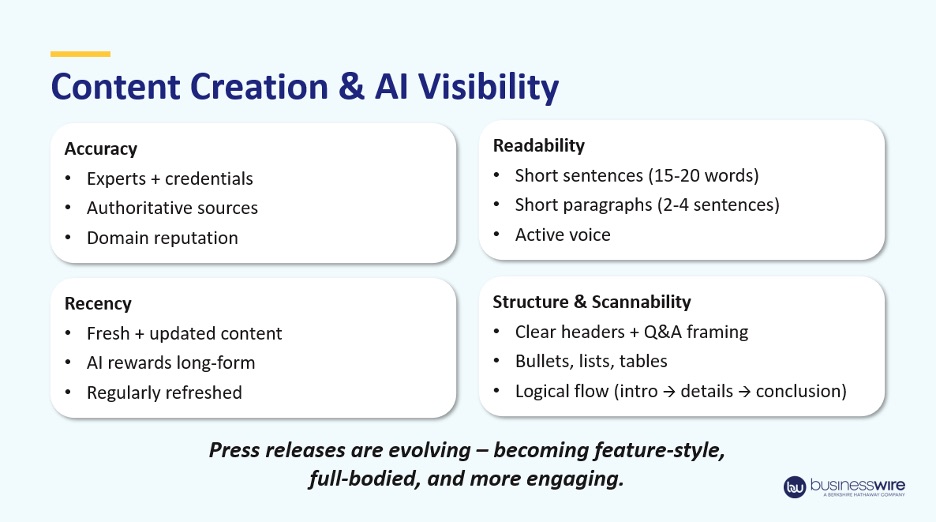
Press releases are more than media alerts; they’re digital assets designed for longevity and search. Emily outlined four pillars for AI-ready content: Accuracy, Readability, Recency, Structure, and Scanability.
- Accuracy: AI values expertise. Releases should include expert quotes, verifiable data, and reputable domain sources.
- Readability: Use short sentences that contain 15 to 20 words. Keep paragraphs brief with 2 to 4 sentences each. Always employ an active voice.
- Recency: Fresh, regularly updated content signals authority. AI rewards long-form releases that evolve with time.
- Structure & Scanability: Clear headers, bullet lists, and logical flow (intro → details → conclusion) make content easier for both humans and machines to process.
“We’re designing every press release as a permanent digital asset, one that feeds both the press and the algorithm,” said Greifeld. “Visibility should compound over time, not fade.”
At The Pollack Group, we apply this four-pillar framework across every campaign to ensure stories live longer, travel further, and stay visible, not just for a news cycle, but for months or years to come.
2. AI + Search Are the New Gatekeepers
Generative search tools like ChatGPT, Gemini, and Perplexity are now the first stop for information discovery. They scan billions of data points, extracting content that’s clear, structured, and credible, and filtering out anything confusing, vague, or redundant.
Emily emphasized that “AI skips messy content.” Press releases with run-on sentences, unclear headers, or bloated language often go unread. Scanability has become a visibility metric. A well-formatted, logically structured release is more likely to appear in summaries, roundups, and AI-driven news briefs.
Business Wire’s Making News AI-Ready guide reinforces this: releases that are clean, tagged, and logically formatted consistently outperform those written purely for journalists.
3. Credibility Is the New Visibility Metric
Trust drives discoverability. AI and search algorithms now weigh credentials, expertise, and reputation before surfacing content.
For CMOs, that means building authority ecosystems, ensuring every brand statement is backed by credible data and trusted voices. The four-pillar framework’s “Accuracy” element reinforces this: authoritative sources are not optional; they are the foundation of visibility.
4. Global Stories Need Local Voices
Brands with a global footprint must think local to be found. AI and search tools personalize results based on region and language, prioritizing content that speaks to local audiences.
Through our partnership with Worldcom, The Pollack Group localizes campaigns across 115 offices worldwide, adapting tone, message, and timing for maximum relevance. Global storytelling only succeeds when it resonates locally.
5. Measuring Visibility, Not Just Coverage
Traditional PR metrics, impressions, clip counts, and circulation, no longer reflect impact. CMOs need visibility analytics that track:
- AI summary inclusions
- Search performance lift
- Dwell time and engagement
- Sentiment trajectory
At The Pollack Group, we’ve redefined success metrics to measure discovery, not just exposure. The new KPIs show how often your story is surfaced, cited, and sustained over time, not just when it goes live.
6. AI Is a Force Multiplier, Not a Replacement
AI can’t replicate human intuition, but it can amplify it. Used correctly, it enhances research, message testing, and predictive analytics, allowing communicators to move faster and smarter.
“AI can inform communications, but credibility, ethics, and emotion remain human,” said Evan Pondel in his AI in IR insights.
At The Pollack Group, we combine AI-driven tools with human oversight, balancing data precision with emotional intelligence. The result: content that’s algorithmically optimized and humanly resonant.
7. Creativity Still Cuts Through
Even in the AI era, creativity is still the currency of attention. Generative systems help with ranking, but originality is what makes people care. Fresh, emotionally intelligent storytelling outperforms generic announcements.
Business Wire’s Creative Press Release Ideas resource, featuring 100 new angles for announcements, underscores this truth: even the most optimized release needs a strong creative spark to stand out.
The Takeaway for CMOs
The future of visibility belongs to brands that integrate AI-ready precision with human-driven storytelling. This new standard for communication excellence relies on four pillars: accuracy, readability, recency, and structure. To succeed, brands should ensure all content meets these criteria for maximum visibility and impact.
At The Pollack Group, we help brands future-proof their communications through:
- AI-optimized storytelling and message architecture
- Authority-based content strategies built on credible sourcing
- Localized execution powered by our Worldcom partnership
- Performance dashboards that measure true visibility
The new era of earned visibility rewards clarity, credibility, and creativity equally. If your brand is ready to be discovered, not just covered, let’s start the conversation.