How to Effectively Market a Small Business
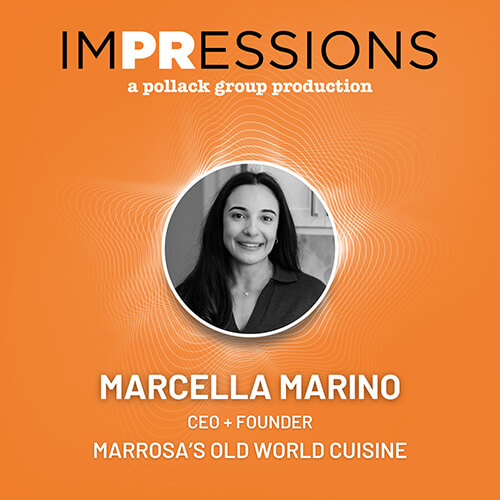
What does it take to turn a family tradition into a growing food brand? For Marcella Marino, CEO and Founder of MarRosa’s, it started in the kitchen during lockdown. In this week’s episode, we sit with Marcella to discuss how she launched an Italian specialty food company while studying Corporate Innovation and Entrepreneurship at Penn State, and grew its presence to more than 200 stores across the Mid-Atlantic, Texas, and Seattle.
Listen to more imPRessions Episodes




Marcella Marino, CEO and Founder of MarRosa’s, started her business during the pandemic while getting her B.S. in Corporate Innovation and Entrepreneurship from the Pennsylvania State University. MarRosa’s is an Italian specialty food line, consisting of 5 sauces and 3 pastas. All the sauces are made with Italian tomatoes, longer cook times to make them less acidic, and no added sugar. The pastas are unique cuts made with semolina and bronze die. MarRosa’s is in over 200 stores across the Mid-Atlantic, Texas, and Seattle area.
Transcript
Kalli: The pandemic reshaped how we connect with people, comfort, and the things that make us feel at home. For some, it sparked creativity and resilience, turning challenges into opportunity. Today's guest, Marcella Marino, CEO and Founder of MarRosa's, did just that. While earning her degree in corporate innovation and entrepreneurship at Penn State, Marcella launched MarRosa's, an Italian specialty food brand rooted in family tradition. What began as a kitchen project during lockdown is now available in over 200 stores across the mid-Atlantic, Texas, and Seattle. With authentic sauces and pastas crafted from Italian tomatoes and heritage methods, MarRosa's shows how small businesses can build trust, create emotional connection, and grow by leaning into story, quality, and authenticity. Today, Marcella shares how she marketed MarRosa's from the ground up and how heritage and heart continue to drive her brand forward. Hi, Marcella, it's such a pleasure to have you on here today.
Marcella: Thank you for having me. I'm really excited about this.
Jenn: As somebody who absolutely loves Italian food, Kalli can probably attest to that as well. I'm sure she does too. We're really excited to talk to you today about your brand.
Kalli: Yes, I came hungry, so.
Jenn: This has been before. I was already like, maybe pasta for dinner tonight.
Marcella: Sorry, I can't give you any through the screen.
Kalli: We should have done this over food.
Jenn: We should have.
Kalli: Next time.
Jenn: So, as Kalli mentioned, you launched MarRosa’s during the pandemic, which is a really special time, I think, because that was definitely a period in which people really needed connection and definitely comfort. You're quarantining, hopefully with people you love and can kind of deal with the craziness of the world through food, right? So how did that sort of shape your brand story and how were you able to resonate with people during such an emotional time period?
Marcella: Yeah, I mean, it was a tough time for everyone. I was actually a sophomore at Penn State when COVID happened. I remember being sent home for a week of spring break and then they said, don't come back. So that was awesome. And then all my junior year, I was at home. So I'm Italian, figured I'd do something with my time. And after taking a semester, my junior year of like an entrepreneurship class, because that's when I started my major, I was like, you know what? This is awesome. I'm sitting at home right now. I might as well do something. And I realized that everyone, you couldn't go to restaurants at the time. So everyone was going to grocery stores and buying food to make at home, experimenting with their own, being creative. And my family was doing the same thing. And I was like, you know what, why don't I jar sauce and like that's starting a business. And that's kind of what I did. So I was able to contact co-packers during this time. And it was a little difficult because you couldn't leave your house. So they were able to send me jarred sauce through the mail and a couple of different variations of it because I told them my idea, what I wanted. I wanted Italian tomatoes to make it different, imported from Naples. I wanted a less acidic sauce. I wanted to find a sauce that wouldn't give me that heartburn, wouldn't burn my lips from the acidity. And I wanted all natural ingredients, so no added sugar. So they were able to give me a couple of versions of that and then I'd say, okay, I like this, but next time can we do this? So it was a lot of back and forth for a couple months, but I was able to get these recipes out and I shared them with my friends, family, and then I started contacting stores. And by this time it was like late 2021. So we were able to I think at that time you were able to leave your house. It was a year of COVID. So you were able to leave your house. I was able to go into grocery stores, introduce myself, and that's where I started. And then my senior year, I went back to Penn State full time and was running it a little bit. And then once graduation hit, I knew I wanted to do this full time. And here I am.
Kalli: That's amazing. And honestly, I remember everyone was making, it was banana bread was like the thing to make. So I love that like as an Italian, like you're like, I'm gonna make sauce. Like, forget, forget banana bread. Because that's what we like, that's, I'm not gonna lie. That's what I eat nine times out of ten. And I all too, I'm very particular about my sauce. And I love that you said that it isn't super acidic because there's nothing that will ruin your Sunday dinner more than heartburn.
Marcella: Yes. So I tell customers that like if you do get heartburn, I mean, everyone's different. I don't want to tell you won't get heartburn. I'm not a doctor. But I get a lot of positive feedback saying people haven't gotten heartburn. So that just feels good in the heart that it's helping people enjoy their meals again.
Kalli: Yeah, that's it's so important, especially for people who love to eat. And you're like, no, don't ruin this for me. So I wanted to talk a little bit about your education in corporate innovation and entrepreneurship. It clearly shows through your business. So I wanted to just dive into a little bit more of how you apply those principles to your brand storytelling and marketing approach.
Marcella: Yeah, definitely. So Penn State, abbreviated it as a CIENT major, CIENT. So if I say that, that's what it means. And as that major, you took different classes. So I took marketing, I took finance, I took accounting, MIS, all different types of business. So it was basically all of the Smeal majors, Smeal's the business school, Penn State, was all those majors in one. And you were able to concentrate on a little piece, the most important pieces of all those things. So in finance, we didn't talk about the stock market. I mean, we did a little bit, but we talked mainly about like how to manage your finances when building a business, accounting, how to do a cash flow statement and all that stuff that I still, I have tons of spreadsheets that I use all of these numbers and that I had at Penn State. So I'm able to still use those spreadsheets now. And I also still use textbooks that I had my junior and senior year in entrepreneurship. Like I read them when I need help with like some random thing. It helps a lot. So the CM major was very helpful. It was a fairly new major at Penn State. But my senior year, I basically ran my business and the professor was our mentor. There was about 10 to 15 of us in the class. It was a two semester course. And Dr. Miller was really helpful. We just ran our businesses and she would give us advice. It was a great major, honestly.
Jenn: And if you can still use your textbooks, because we all know it's not cheap. It's not cheap to get those books. So the fact that you can still use it today in your business is amazing.
Kalli: I love that you're using it in your business and not just like to keep your table balance too. Like that's also really.
Marcella: So I guess I shouldn't consider them textbooks because they were, like I'm looking at one right now. It's like a paperback. They're from Amazon, but our professors recommended them because they were just so good. So I just kept on. I was like, why throw them out?
Jenn: And what I love too about your brand is it's very authentic and it's very kind of driven in your heritage. So tell us a little bit about how you communicate that through your marketing, especially like through social media without being like too commercial, because like you're not a corporate brand. You're your own brand. You have started your own business and you're doing this completely from scratch, which is amazing. So how do you keep a sort of like a polished brand and story, but also kind of have that heritage and that family feel to it that makes it feel very raw and authentic.
Marcella: Yeah, I mean, social media, I feel like it's changing all the time of what people want to see. And lately I've noticed that when I'm in the picture or in the reel, it gets so many more likes, so much more engagement that it's like actually incredible. I was just looking today and I gained like so many followers this month just by posting a couple pictures of myself. So I've learned that people really want to see the founder. They want to know what's going on behind the scenes. I still post graphics to describe like the different sauces and pastas and everything because I think those are still important, like design graphics and stuff. But being able to show who's the person behind the brand is really important. And I think customers enjoy knowing like, this is the actual girl who's the business owner. Like when I go to stores and introduce myself, they go, this is actually you. And I say, yes, that is my silhouette as logo. It's actually my Disney World silhouette when I was five years old. But it's just people like to know who's the person behind the brand. And I still like, yeah, I'm Italian. I show my heritage through. I mean, you can just look at me. But people like knowing what's behind this brand. It's not a big corporation that owns it. It's me.
Jenn: I love that. And were you always a cook? Like were you a little girl helping people in the, you know, family members in the kitchen? Or was this kind of like a passion project that just sort of arose through the pandemic?
Marcella: Yeah, so my dad's 100% Italian and my mom's about 25. And they're both big cooks. I remember both sides of the family every holiday there'd be like tons of food. We've always had leftovers. I was always in the kitchen when I was allowed to be, because sometimes when I was little, kids get in the way. So, but once I grew older, yeah, I was always allowed in the kitchen, like just do whatever, I'll do whatever you need me to do. I enjoy cooking and then COVID I think I was stuck home. So I really, I got more into cooking because I had nothing else to do. And now I really enjoy it.
Kalli: You're in 200 stores now, which is huge for a brand that's so young, that is barely able to reach the countertop this week. So what PR or brand building efforts helped you reach that kind of visibility and the trust with those retailers? Like I know you mentioned like that you've gone into some of the stores and you've, you know, you're putting your face on your social media? What are those tactics that you're using to really push that?
Marcella: Yeah, when I approach a new store, I tell the buyers or the owners, like my story that I just mentioned earlier, I went to Penn State, started this during COVID. And that kind of just like, they're like, wow, the actual owner of this company is coming in and introducing herself. And I think being present with the stores is really important. Like having the actual founder there. There's a lot of brands I know where they just have a salesperson and they don't know what stores they're actually going to, who's shopping at these stores. So that's just big on me. Like what I want is I want the customers and the store managers and buyers to know who I am. Like who's running this company behind the scenes. But trust with the buyers definitely takes time. Whenever I approach a new store, I tell them I will always keep that shelf stocked. Having an empty shelf is a big pet peeve of mine. I do not like when there's no product on the shelf because it loses money for the store because it's an empty space. And it also loses sales for me because say someone wanted to go into a store and buy my vodka sauce and there's none on the shelves. Then I lost a sale because they probably tried another brand. And it's just important to keep that shelf stocked. And when you do that, the retailers trust you more because they know I'm not going to lose money for them. And then over time, when they see that I keep coming back and stocking that shelf, they'll give me more shelf space. So I think that's important. Having more shelf space more facings so that more customers can see me, see my brands, my products.
Jenn: Yeah, that's a really great point. It's really important to keep that visibility because you're right, like somebody needing to buy sauce or a specific product, if yours is not available, they're just going to go somewhere else, right? They have to eat, they have to prepare dinner. So if it's not you, it will be someone else. So I think that that's really great advice for people looking to start their own business that, you know, are going to have like a physical, tangible product. What was sort of, because I think every brand, small or big, has had like that moment, like that aha moment, like this is happening. Was it like a piece of coverage in like food and digest? What was it for you that made you kind of stop and think one day, oh, like this is my big break. Like this is the thing that's really putting MarRosa’s on the map.
Marcella: Yeah, so this is actually kind of a little story background before I get to the big aha moment. My senior year at Penn State, I participated in a competition called Inc.U. It was during Startup Week at Penn State, which is basically a week of entrepreneurship events and a bunch of speakers come, they have competitions. And I participate in the Inc.U competition, which is basically Penn State's version of Shark Tank, but with no equity, it's just you win money. So it was a $30,000 pool of money and there were six teams. I was the only person that was a solo person. And so you could win 30,000, you could win 10,000 or 15,000, however they decide to give that 30,000 to six teams. So it actually turned out I won 15,000 and another team won 15,000, which was amazing. So I used that 15,000 to go to the fancy food show in New York City at the Javits Center a month after I graduated, actually. It was in June. I graduated in May. So it was a big turnaround. I was in the startup pavilion there. So I had a little like 5-by-5 booth, I guess. And on the first day in the first hour, the buyer for Central Market down in Texas approached me and said, I want your sauce in my stores. And at the time, I had only been to Texas once. I was still new to the program and all this. And I was like, that's awesome. Let's do it. And then nine months later, I was in their stores. And now I'm in 10 stores down in Texas. So that really got me on the map. It got me out of the mid-Atlantic and into different stores. And being in Central Market is like, you made it. It's a premium store. I don't know if anyone knows what H-E-B is, but it's like a big store down in Texas. There's thousands of them. They own Central Market, which is a premium store, high end, and you find such a niche food items there. It's so much fun to go to. Every time I go, I just stand there. It's so fun. So if you ever go to Texas, go to Central Market and get some sauce. But yeah, that definitely, that was like my big break moment is like, wow, I'm actually doing this. I'm getting my products like across the country, halfway across the country.
Jenn: That's such a cool story.
Marcella: So it's like kind of a long story, but Yeah, it's fun.
Kalli: That's amazing. And I love that you're sharing all these stories with us because look, especially in the specialty food industry, storytelling is everything. Visuals are everything. So how do you approach branding to make sure that people aren't only tasting your product, but also are feeling your story through the packaging and the social content? I know you said you have your, I love that it's your Disney World caricature from when you were little. Like that's so special. Like how, do you leverage those types of things to bring your taste to life?
Marcella: Yeah, well, I've learned that it's nearly impossible for me to tell my story to every single customer because I'm not in every single aisle 24/7. So I do do demos in grocery stores A lot. Like once a year, I go down to Texas and do demos at the six stores down in Dallas. And I try and tell my story to as many customers I can during those demos because it brings them back to wanting to help support me and get my sauce another time and just be a loyal customer. I do have a short story on my label. Not sure if many people read it, but a lot of people do read it actually because they want to know what's behind this and everything. It says it has the story behind the logo, my silhouette. And I don't know, just doing tastings in stores, I think it's really important because I can tell people how my sauce differentiates itself from other brands. And people really like having the actual founder there because they can ask me questions or about my story. I don't know, I just find it really important to be in the store doing the demos. I've never, I have a friend out in Seattle who helps me do demos out there. She's a friend from Penn State actually. But yeah, other than that, I do all the demos. I do most of the farmers markets because I find it important that I should be talking to my customers who's supporting me.
Jenn: Yeah, I think that's a really great point and something I was going to kind of get to next that we've talked a little bit about already. Is sort of the importance of customers kind of knowing the why behind a product. And I, for one, especially when it comes to like a small business product, if they have the story on the label or wherever, I always do read it because I think it's really special and it humanizes the experience and the brand. And I just think that that's I don't care about, a big brand, I really don't, a big conglomerate that's making all this money, but a small business, such as yours, I think that it's really interesting to kind of know how this came about and why this particular person launched this brand or this product or this service. So I think it's really neat that you're doing that. So I know you said that you're showing more of a presence on social media and that is really increasing your engagement and your followers because people like to see the face of the brand. What are some other ways that you're including your personal journey into your PR and marketing? Because while you don't want to make it too much about you, it is you, right? It's your brand, it's your complete idea and people kind of want to see that. So how are you integrating your personal journey and your personal passion into the PR marketing in your brand?
Marcella: Right. I mean, I've always been a healthy eater growing up. I've just always wanted whole foods and not crap food, I guess. Like going to McDonald's doesn't excite me. No offense to McDonald's. But I wanted to find a sauce that was all natural ingredients and it was tough out there. Like a lot of them have added sugar. A lot of them have sodium that like the sodium content is like astronomical. And I just wanted to make something different. So I wanted all natural ingredients, which I tell people mine are pure tomatoes. It's not tomato puree. There's no water to dilute the tomato. It's pure tomatoes, which a lot of people actually like. They don't want this canola oil, the sesame oil or whatever oil some of these brands put in them, just pure extra virgin olive oil or olive oil. So I tell a lot of customers, I personally, I look at the nutritional label and whatever one looks best to me is what I buy when it comes to granola bars, for instance. I always look at labels. And if I see that there's like a random, I don't know, something that shouldn't be in there, I don't buy it. So I tell a lot of customers, like, if you don't like mine, at least compare it to another label that you're going to buy and look at the ingredients, look at the sodium levels, look at the sugar levels, because that's important. Even though it's not high in like calories, the sodium being high is like not good either. I mean, I'm not a doctor, I'm not going to give you like a nutritional lesson, but from my personal opinion, I'd rather have pure tomato and no extra oils that you don't need. I'm not sure if that really makes any sense, but just having full ingredients is more important to me than taste, honestly. I mean, mine tastes excellent without all that extra stuff, but some of these brands add sugar to make it taste better and you really don't need that.
Kalli: I love the idea that you really are showing up personally in the brand story so much. How do you differentiate when to tell the story and then when to let the product speak for itself? Because obviously, like you said, the product is people are loving it once they taste it, and there's also a great story behind it, but how do you kind of separate those two when needed?
Marcella: Yeah, so whenever I go to demos and I have someone try my sauce and they're like, I'm not interested in buying any right now, but I do in the future. I just say, I literally have this on repeat. I say, just remember that logo. That is me when I was 5. And that kind of connects with people like, wow, okay, she's actually that person on that label. And I think it helps them remember like the girl I met is the logo or is the silhouette. So kind of speaks for itself then. When I sell on the shelf and I'm not there because people can remember me instead of a legal. Like I was in the Main Line Today magazine, which is a local magazine in this area in the August issue. It was a 20 Under 40 influencers, I think it was called. And this past weekend I was doing a demo and two different women came up to me and said, I recognize you from that magazine. I was like, yes, that is me. So I think they saw the jars and then they saw me because I wasn't wearing makeup on Saturday doing this demo, but it was in the magazine. So I think just seeing the label kind of resonated with them because my story was in the magazine also. So it connected like, oh, this is that girl. So I think my logo helps a lot and speaks for itself when I'm not there.
Jenn: Definitely. Well, and again, it's a silhouette of you as a child. I love that, you know, and it also just shows A, the human side, right? That human element that we were talking about before. Yeah.
Marcella: I'm not a billion-dollar brand.
Jenn: Yeah, right. You're a real person who has this real passion and this real talent and has created that into a business to help people, to give them quality sauce for dinners with family and dinners with loved ones and whatnot. So, I think that that's a great way to say, like, just remember the logo is me. Like I'm still this little girl on the inside that grew into this woman that has created this really authentic brand. And I'm sure it's difficult right in the market to be, it's difficult in the world to be a woman, but let alone like a young female entrepreneur. So can you give our listeners a little bit of insight on how you kind of navigate the world of business as a woman, kind of doing this business venture on your own. And how do you stay consistent from just kind of being authentically yourself? You have this vision, you have this amazing product and this company that has now come to life, whether it's on the shelf or on social media, how do you portray that? And what is some advice that you could give to maybe some women that are in college or young women that have this idea that want to start a business.
Marcella: Yeah, I would say just go for it. Like no one's gonna stop you. Have a support system behind you. And in my business, I just like to stay consistent with people. Like if you're not showing up, they're not gonna remember who you are. You have to be in their face. Well, not in their face, but like follow up with them, talk to them when you see them. Don't just ignore them. Like whenever I'm in a grocery store and I see the buyer or the owner or someone in the grocery department, I always make a point to talk to them because they're the reason you're being so successful in that store is they're helping promote you. So I'm always reachable. Any of these stores, I'll answer a phone call. I always answer my email. Instagram, I'm not big on answering because sometimes it just goes into the request page and I don't see it. So I missed a couple of those. So I apologize to my customers. It doesn't tell you. I don't know if you guys have an issue too, but I find it important for me to be at those demos, at those farmers markets, at everything I could possibly be at to get my brand out there. This week I'm actually doing the Good Food Fest. It's sponsored by Kimberton Whole Foods in the Philadelphia area and a bunch of local brands will be there and I'm going to be there. I find it's important that I'm there and not hiring somebody else to do it because customers want to see me.
Kalli: Thank you so much for sharing this insight. And it really is important to make sure you're cutting through all the noise like we were talking about. And so for other founders listening, What is one PR or storytelling lesson that's really resonated with you and that you learned and that you wish every early stage entrepreneur knew?
Marcella: Yeah, this is a big one. My dad actually told me this when I was before starting out. He said, you have to spend money to make money. And at the time, I was just, I've always been very conservative with my money. I've been working since I was 14, just saving my money. And at that time, my dad was like, you have to spend some of this money to actually make money. You have to advertise, you have to spend it on marketing materials and all that stuff that you don't even think about. And it's true. Like if I don't spend money on say an ad in a magazine, I'm going to lose those people that read that magazine aren't going to see my brand. I'm not going to get more customers. So spending money is important. Don't overspend, but it's important to spend a little bit on advertising, on doing these events. Like a farmers market, you'll pay $25 to go to a farmers market, but you'll make it up and on your sales. Like you have to sell a certain amount of jars to cover that cost, but then you'll be making more money anyway. So yeah, learning you have to spend money to make money was tough for me, but I succeeded and did it. And I always have to see the ROI in things.
Kalli: I'm so happy that you are seeing that ROI. Really, congratulations on all your success. And your story is such a powerful example of what happens when authenticity meets ambition. From launching MarRosa’s during the pandemic to building a brand that is now in more than 200 stores, which is amazing. You've created something that resonates far beyond the shelf. It's been such a pleasure having you on today and hearing how your passion and your purpose continue to drive this journey. As always, a big shout out to our listeners. Thank you so much for tuning in and we hope you enjoyed today's conversation and are leaving as hungry as we are. Now I'm looking for MarRosa’s sauce. Be sure to follow The Pollack Group on all social channels for future episode information and reach out to impressions@pollackgroup.com.
Solutions
Some communications challenges call for a more focused approach. The Pollack Group’s proprietary solutions combine decades of communications experience with specialized methodologies, technology and audience intelligence to help organizations solve specific business and reputation challenges. From strengthening messaging and preparing for a crisis to understanding audiences, elevating leaders and measuring how brands appear in AI-driven search, our solutions give organizations practical tools and insights they can put to work.
Connect to Lead
We believe in creating transformational value - not just transactional.
Leadership Now
Creating leadership platforms that are essential to building audience trust and confidence.
Outmaneuver
Count on us to find ways to overcome the barriers - and out-think the competition.
Activate Now
We help you prioritize and focus on the sources of influence who will drive ROI.
CrisisGuard 365
Your ‘always on’ crisis communications partner available 24/7/365