Sited Visibility Index: Black Friday Retailers Leading AI Search
TL;DR
- Best Buy dominates AI search, coming out on top in GEO Awareness (75%), Share of Voice (15%), Mention Position (2.3) and Sentiment (7.3).
- Walmart and Amazon remain a large part of the conversation, appearing in 69% and 62% of AI answers, respectively, but still trail behind Best Buy.
- Visibility isn’t the same as favorable sentiment, as is seen in Walmart’s case. It ranks second in GEO Awareness but gets a 6.3 for service and trust.
- Costco faces the opposite problem as Walmart, appearing in only 18% of AI-generated responses despite earning the second-highest trust score (7.0).
- Retailer websites aren’t the only sources influencing answers, because price-tracking platforms like CamelCamelCamel and Keepa rank among the most frequently cited URLs.
Black Friday is approaching and gone are the days of camping out overnight outside Walmart and fights breaking out over big screen TVs. Today, Americans are shopping online, monitoring price tracking sites and taking recommendations from AI. The hunt for the best deals will probably never go away, but how consumers find and compare them has changed dramatically.
Electronics remain a major focus of Black Friday shopping, and rather than browsing multiple retailer websites or sorting through countless promotions, shoppers can now ask generative AI platforms to compare deals, recommend retailers and help determine which purchases are worth making. But which retailers are earning the most visibility in AI search, and how are they being positioned?
For this month’s Visibility Index, using data from our GEO solution, Sited, powered by Brandi AI, we examine how five major retailers perform in AI-generated responses about Black Friday electronics deals.
Methodology
To understand how AI platforms recommend retailers for questions about Black Friday, specifically about buying electronics, we analyzed five major brands: Best Buy, Walmart, Amazon, Target and Costco.
We monitored 20 unbranded prompts designed to reflect common consumer questions about Black Friday deals, including where to find the best discounts, which retailers offer competitive pricing and how to shop for specific electronics categories. For example:
- “What are the best Black Friday TV deals to watch for this year?”
- “Which Black Friday tech deals are actually worth buying this year?”
- “Where can I find early Black Friday deals on gaming accessories and controllers?”
- “How can I track rewards, coupons and member perks on Black Friday tech purchases?”
- “How do I compare Black Friday prices to catch scams online and in-store?”
The audit examined 291 AI-generated answers over a seven-day period in November 2026.
GEO Awareness
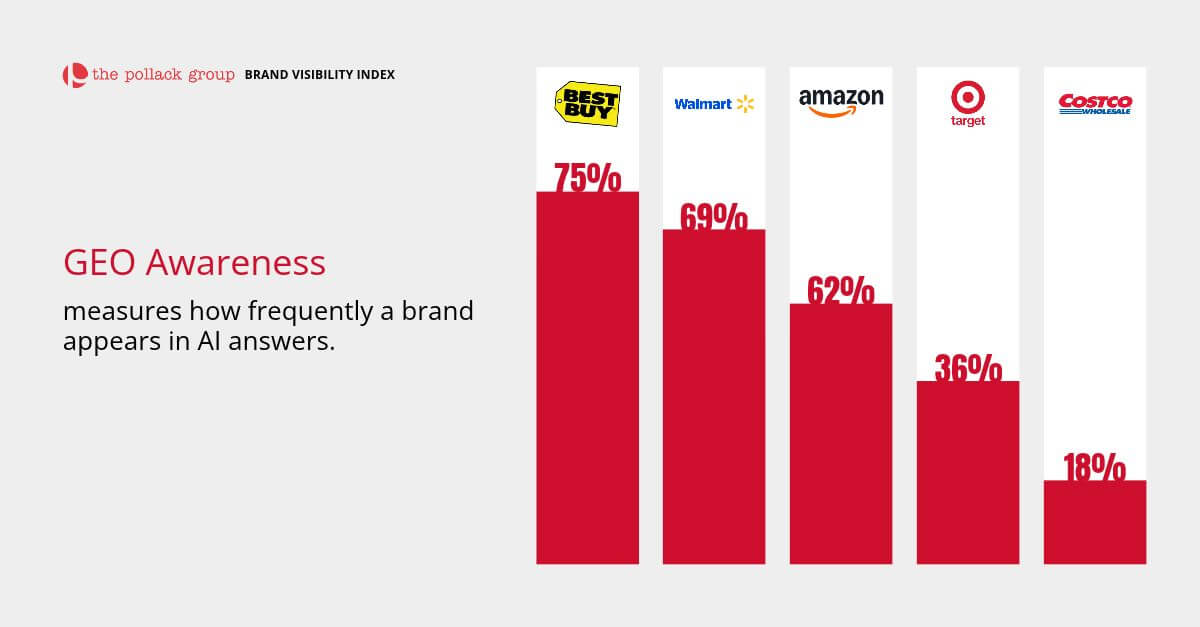
Best Buy ranked first in GEO Awareness, appearing in 75% of AI-generated responses to questions about Black Friday electronics deals. Walmart followed at 69%, with Amazon close behind at 62%.
Visibility dropped considerably for the remaining retailers. Target only appeared in 36% of responses, and Costco in 18%.
The disparity indicates a clear divide between the top retailers (Best Buy, Walmart and Amazon) and their competitors (Target, Costco).
GEO Share of Voice (SOV)
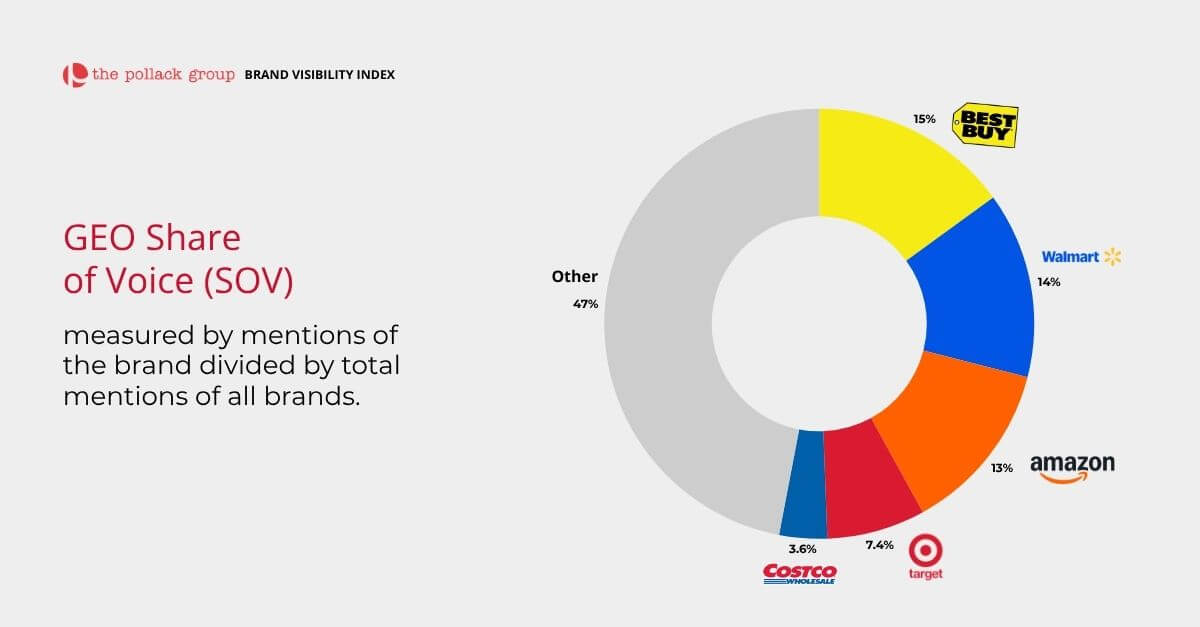
GEO Share of Voice measures mentions of a brand divided by total mentions of all brands. While Best Buy holds the lead in Awareness, the competition becomes closer in this category, where Best Buy earned a 15% SOV, followed by Walmart (14%) and Amazon (13%).
The narrow margin suggests the three retailers maintain relatively similar levels of representation across the broader competitive conversation, even as Best Buy appears in a greater percentage of individual answers.
Target and Costco lagged behind, recording 7.4% and 3.6% SOV, respectively.
Mention Position
As is true of traditional SEO, it’s important to analyze where a brand ranks when GEO yields a list of recommendations. Whether it’s listed first or last (i.e., the “Mention Position”) can tell us a lot about brand positioning.
Best Buy recorded an average Mention Position of 2.3, meaning it usually appears as the second or third list item. It outperformed Amazon (2.9), Walmart (3.6), Target (4.0) and Costco (5.7).
For consumers using AI to narrow their shopping options, placement is particularly important. Retailers appearing near the beginning of an answer may receive more attention than those positioned farther down a list of recommendations.
Sentiment
Black Friday may be synonymous with discounts, but price is just one of many factors that AI highlights when describing these retailers. The Sentiment Analysis evaluates brand perceptions across five categories on a scale of 1-10, including convenience, product selection, service and trust.
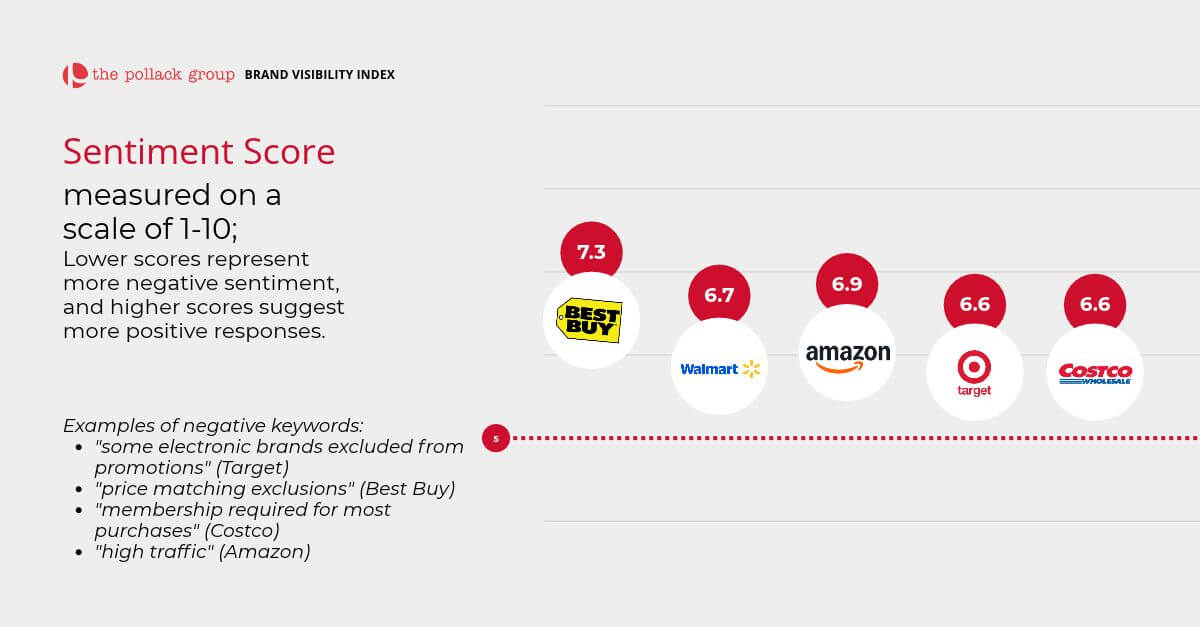
Best Buy led the Sentiment rankings with an overall score of 7.3, followed by Amazon at 6.9, Walmart at 6.7 and Target and Costco at 6.6. But the distinct Sentiment categories reveal nuances to each of these rankings.
Best Buy either led or tied across all five categories. The brand consistently earned between 7.3 and 7.5. Its favorable scores suggest that AI platforms position the retailer as a standout option beyond its Black Friday deals alone.
Amazon had ratings in the 7s across all categories except trust, where it earned a 6.4, revealing a notable gap between how AI evaluates its pricing and its perceived reliability. Walmart experienced a similar disconnect; despite ranking second in Awareness and SOV, it earned 6.3 for both service and trust.
Costco experienced the opposite, with the lowest overall visibility but impressive Sentiment scores. It earned a 7.0 trust score, second only to Best Buy. Its product selection score of 7.1 also exceeded those of Walmart and Target. The findings demonstrate that a retailer’s visibility in AI-generated search results doesn’t necessarily reflect how favorably it’s described.
Brands must also consider what conversations are happening on platforms like Reddit and social media, where real customers leave their most honest reviews. Even if these sources carry less weight in other contexts, they can be credible and realistic when citing audience perception.
Cited Sources
AI search engines pull information from a variety of sources, including both owned domains and third-party sites. In this audit, Best Buy led in domain citations, with its website referenced in 47% of all analyzed answers. Walmart followed at 34%, while Amazon recorded 19%, Target 16% and Costco 8.2%.
The gap between Best Buy and Amazon is significant. While their Awareness scores differ by only 13 percentage points, Best Buy’s domain citation rate exceeds Amazon’s by 28 percentage points. A domain with citable content can generate even more visibility and gives the brand a better opportunity to create and control their desired narrative by redirecting customers to proprietary content and messaging.
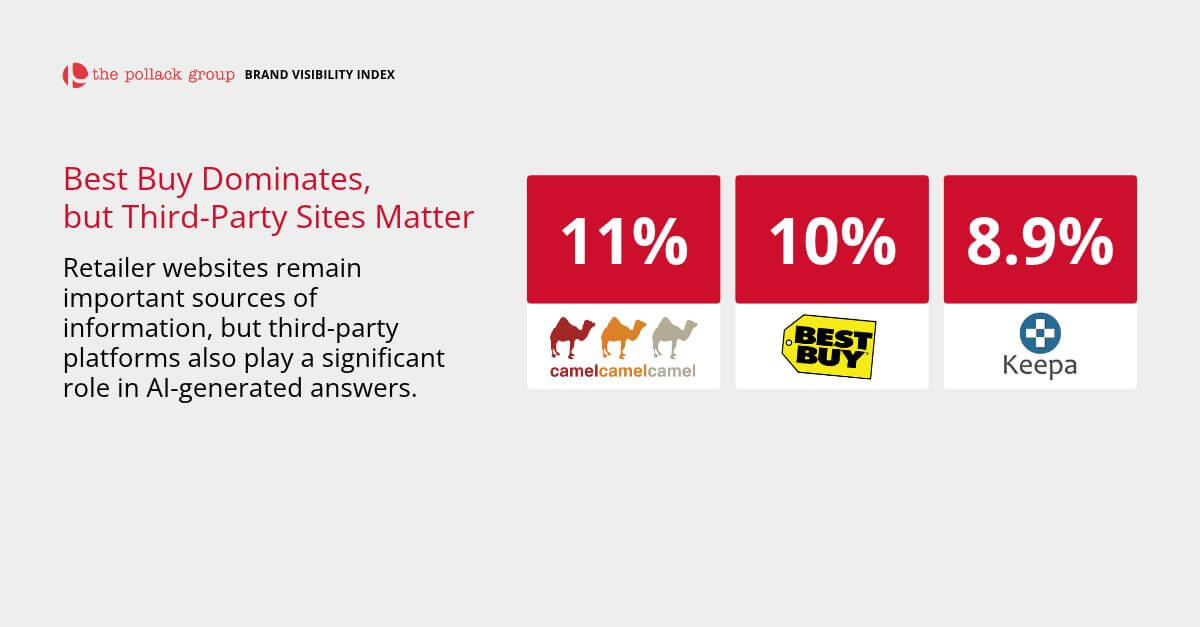
The most frequently cited individual URLs, though, reveal the importance of sources beyond retailer websites. CamelCamelCamel, an Amazon price-tracking platform, ranked first among individual cited URLs at 11%, followed by Best Buy’s homepage at 10% and Keepa, another Amazon price-tracking service, at 8.9%.
Other frequently cited sources include Walmart and Amazon’s homepages, Best Buy’s 2026 holiday calendar, Best Buy’s dedicated Black Friday page and a WIRED article covering early Black Friday television deals.
For brands, these findings underscore the importance of maintaining accurate, accessible information across both owned and third-party channels. A retailer’s website remains a valuable source, but the broader digital ecosystem also contributes to how AI presents its offerings.
What the Laggards Are Missing
For Walmart, the primary challenge is not visibility. Its Awareness and SOV scores place it among the leading retailers, but lower Sentiment scores for service and trust suggest there’s room for improvement in how AI characterizes the shopping experience.
Amazon has an opportunity to improve perceptions beyond pricing and convenience. It has a relatively low trust score, combined with a domain citation rate substantially below Best Buy’s.
Target and Costco have a broader challenge of general visibility in the Black Friday category. Both retailers offer technology products as part of a much wider merchandise selection, which could explain why they appear less frequently in AI-generated recommendations specifically focused on electronics deals. It does not necessarily indicate a weakness in their Black Friday offerings.
Seeing It in Action
To see how AI responds to Black Friday electronics shopping questions, see an example below.
Prompt: Where should I shop on Black Friday for deals on electronics?
Answer: For Black Friday 2026, I'd start with a handful of major retailers rather than checking every store. Electronics deals are usually worth comparing across Best Buy, Walmart, Amazon, Target, and Costco.
Here are the places I'd prioritize:
Best places to shop for electronics
1. Best Buy
Best overall electronics selection
- TVs, laptops, gaming systems, headphones, appliances.
- Great for comparing models and checking open-box deals.
- Website: Best Buy
2. Amazon
- Headphones, smart home devices, tablets, accessories.
- Compare prices against other retailers before buying.
- Website: Amazon
3. Walmart
- TVs, laptops, gaming accessories and budget electronics.
- Particularly worth checking for lower-priced options.
- Website: Walmart
4. Costco
- TVs, computers, laptops and bundles.
- Check extended warranty benefits and included accessories.
- Website: Costco
5. Target
- Apple products, headphones, speakers, gaming and smart home products.
- Look for Circle offers and promotions.
- Website: Target
When to shop in 2026
Deals already available
Black Friday is Friday, November 27, 2026. You don't necessarily need to wait until then.
| Retailer | Important sale dates |
|---|---|
| Best Buy | Main sale Nov. 19–28 |
| Amazon | Nov. 19–30 |
| Walmart | Nov. 23–29 |
| Costco | Major deals Nov. 27–30 |
Put Your Brand to the Test
The analysis is created with Sited, The Pollack Group’s solution for GEO and online visibility improvement powered by Brandi AI. Curious where your brand ranks in these same AI conversations? We’ll run your category through Sited and show you exactly how and why you show up, or don’t. Let’s talk.
The Latest
Stefan Pollack Recognized as a 2026 Inspiring Leader for Second Consecutive Year
Stefan Pollack earns his second consecutive Inspiring Leader recognition in 2026 for his commitment to people-first leadership, mentorship and workplace culture

How to Choose a PR and Creative Agency for Brand Storytelling
What to expect from an agency that combines PR and creative, the evidence to request, a scored checklist and a shortlist template for brand managers.
Looking Ahead to 2027: Our Predictions for PR and Marketing
What's ahead for PR and marketing in 2027? The Pollack Group shares predictions on AI search, brand reputation, discoverability and communications trends.

How to Choose a PR and Marketing Agency for Your Industry: A Buyer’s Guide
How to choose a PR agency for crisis, nonprofit, B2B tech, fintech, consumer, food and beverage or startup needs: criteria, proof and pitch questions.