
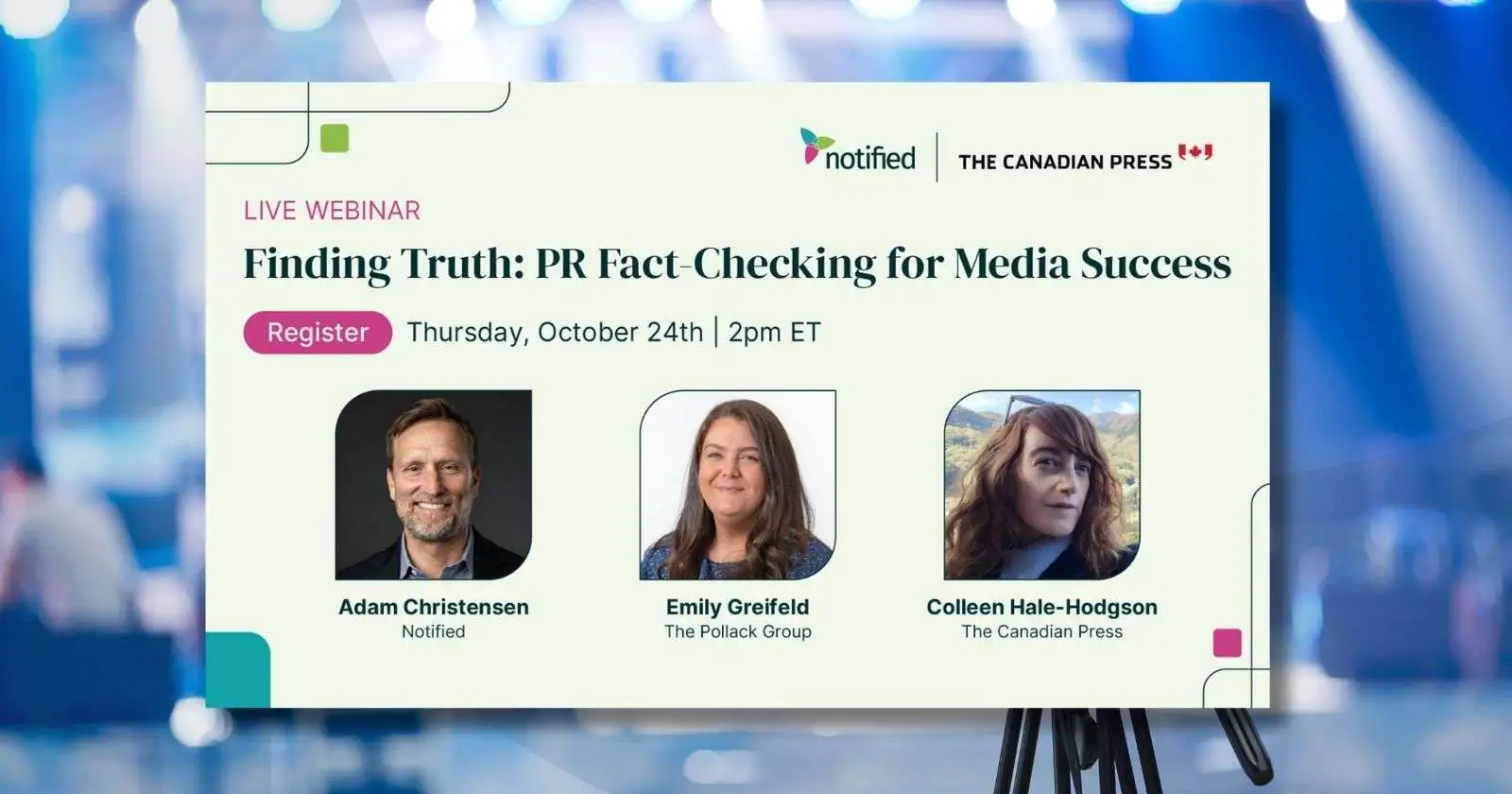
Finding Truth: PR Fact-Checking For Media Success
As trusted messengers of the public, media professionals wield a great amount of power. But with this ability to influence and inform others also comes a responsibility to be honest, transparent, and truthful. Just like reporters and editors, PR professionals have a duty to separate fact from fiction when disseminating information.
Adam Christensen, chief marketing officer of Notified, moderated a webinar with media experts Emily Greifeld, vice president of The Pollack Group, and Colleen Hale-Hodgson, fact-check coordinator and production manager for The Canadian Press. Through candid conversation, the three seasoned professionals shared their insights on the creation and promotion of truthful media in the communications landscape.
Fact vs Fiction
Most of us are glued to various social media apps, and head to either Instagram, TikTok, or LinkedIn to consume information. But how can we tell what’s real and what’s not?
A story deemed worthy of a fact-check is one where big names promote and repost the same claim. “I look for posts that are going viral, have been repeated on multiple platforms, or have misleading images,” revealed Hale-Hodgson. “If a post only has 5 likes and 20 views, that’s not a good candidate for a fact-check.”
“Monitoring and finding claims is not always as easy as you might think,” she affirmed. The key to fact-checking is to catch misinformation before it spreads – a difficult task due to the speed at which stories spread, especially on social media.
The recent AI revolution presents an even greater challenge when distinguishing fact from fiction in the media. “Generative AI can lie to you very confidently – even if you are asking on the basis of truth,” cautioned Hale-Hodgson.
On the other hand, consulting AI can assist with creative content creation in PR, such as developing new pitch angles for clients. “As a communicator, AI has been awesome for us. I run ideas I have past it. It's been hugely helpful,” added Greifeld.
However, AI is not completely replacing human labor in the media world just yet. “It’s not substituting my job. I'm still the one writing. But it’s helpful with brainstorming in my day-to-day.”
Responsibilities in Media Relations
With a range of responsibilities, prominent obligations which media professionals have are responsible storytelling and honest communication. “As storytellers, we need to make sure that the story we’re pitching out is truthful. Mistakes happen – just identify them immediately,” urged Greifeld. “Timely corrections signal that your brand values honesty over saving face. Ignoring misinformation erodes public trust and damages the brands you’re representing.”
When fact-checking, it’s crucial to link a claim to tangible evidence. “When we’re reaching out to PR professionals, we’re looking for a specific claim that has been made about a certain brand,” admitted Hale-Hodgson. “We’re looking for concrete things like numbers, videos, reports, or virtual data to show readers that we’ve traced back the claim and it’s false.”
Moderator Christensen posed a thought-provoking question to his panelists: how can a media professional simultaneously balance client needs and a commitment to journalistic transparency?
“Create a messaging architecture,” recommended Greifeld. “Make sure your key points are based in truth.”
Fact-Checking Methodology
Whether you’re creating or consuming media, preliminary fact-checking can be conducted independently to identify and resist misinformation in advance, a process known as “pre-bunking.”
The fact-based approach to pre-bunking includes addressing misinformation which is expected to appear ahead of an event. For example, if polling locations for elections change, you would take action in advance knowing the annual event is approaching. However, it’s important to avoid sparking conspiracy theories and propagating misinformation with this technique.
The logic-based approach includes training your audience to recognize misinformation using manipulation techniques and media literacy skills. This can look like cherry-picking facts, citing fake experts, or decontextualizing information from its authentic state.
Finally, there is the source-based approach, in which sources are identified as reliable or unreliable. Examples of trustworthy sources include primary sources, government reports, and university research.
With these fact-checking techniques at their disposal, content creators and consumers are better equipped to engage viewers honestly and meaningfully.
Speed vs. Accuracy
Working in the media means always being ready to react to news. With a need for speed and accuracy, what is the key to balancing both?
“It’s important to get something out there, even brief one-liners that get expanded on later,” said Hale-Hodgson.
Greifeld seconded the ideal scenario in which one acts quickly and truthfully. “The first step is to acknowledge the error, then communicate that there’s more to come. Sitting back and taking a breath before you respond is always a really good idea.”
PR professionals should own their mistakes – failing to do so can make the brands they represent appear as though they’re gatekeeping, leading to a loss of public trust.
Magnifying Misinformation
To ensure accurate and efficient communication at work, media professionals are encouraged to learn the drivers of false information. “It can be really useful to understand how people come to believe misinformation,” insisted Hale-Hodgson. “Emotional language is also a key technique seen all over the internet. The more emotions you show, the easier it is for people to relate to you. Unfortunately, that's used to manipulate misinformation techniques.”
Christensen also endorsed the psychology of the media, and insisted that understanding the way information is synthesized can inform more efficient strategizing, pitching, and promoting.
Between fact-checking, trusting reputable sources, surveilling online platforms, and responding promptly, media experts have a lot to consider while on-the-job. Above all, it’s critical to stay true to the facts and remain upfront with audiences when curating and boosting content.
“Trust, transparency, and truth are important in our jobs, yet often get lost because we’re moving quickly to get a story out,” emphasized Greifeld. “Just be as prepared as you can ahead of time.”
The Latest

Stefan Pollack Recognized as a 2026 Inspiring Leader for Second Consecutive Year
Stefan Pollack earns his second consecutive Inspiring Leader recognition in 2026 for his commitment to people-first leadership, mentorship and workplace culture

How to Choose a PR and Creative Agency for Brand Storytelling
What to expect from an agency that combines PR and creative, the evidence to request, a scored checklist and a shortlist template for brand managers.
Looking Ahead to 2027: Our Predictions for PR and Marketing
What's ahead for PR and marketing in 2027? The Pollack Group shares predictions on AI search, brand reputation, discoverability and communications trends.

How to Choose a PR and Marketing Agency for Your Industry: A Buyer’s Guide
How to choose a PR agency for crisis, nonprofit, B2B tech, fintech, consumer, food and beverage or startup needs: criteria, proof and pitch questions.