December 11, 2025
Navigating The Future of PR and Communications: Expert Predictions for 2026
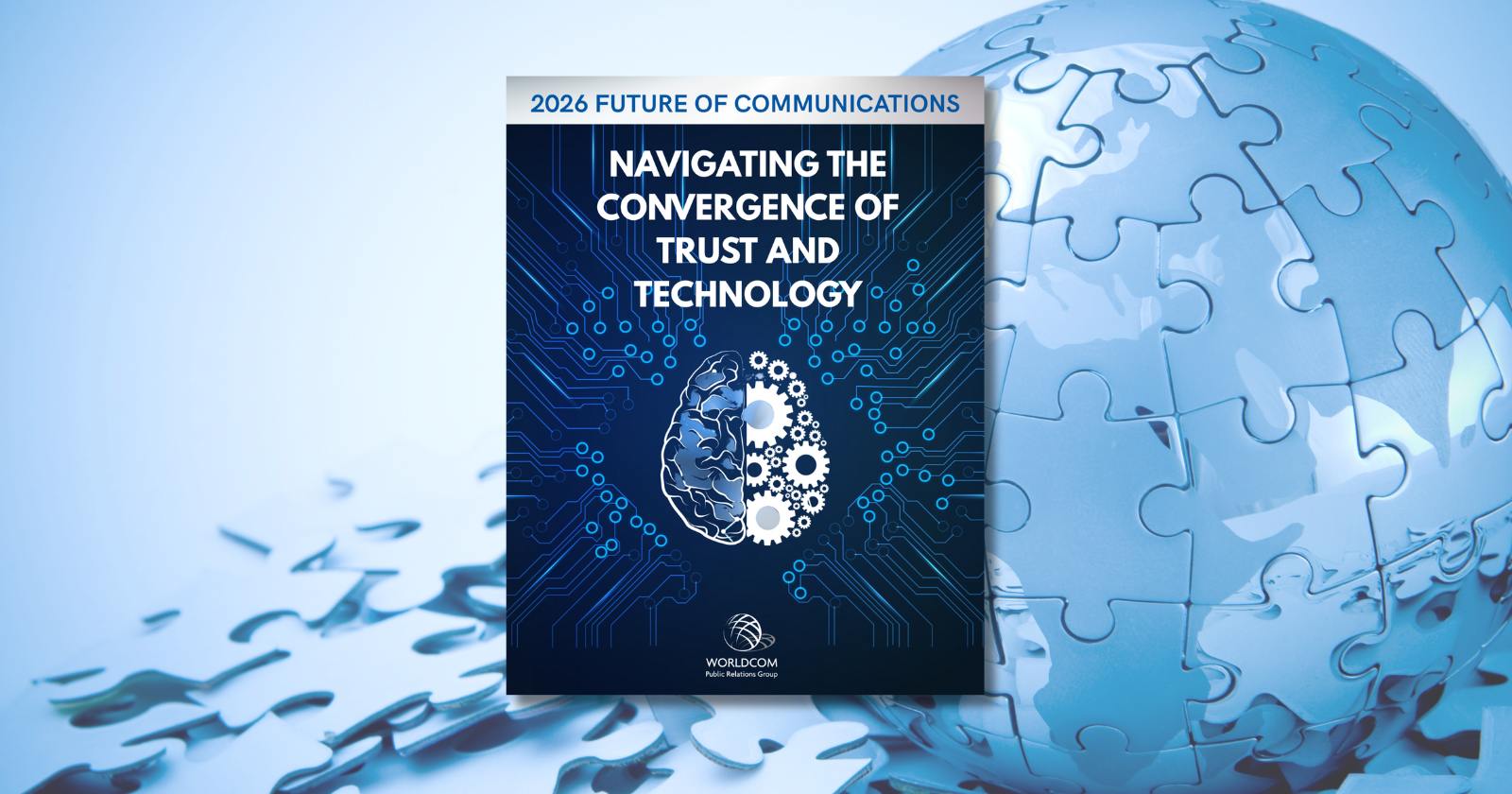
As AI continues to expand its impact across industries, how should PR professionals get ready for all the challenges it brings to the table? Experts from the Worldcom Public Relations Group shared their predictions and advice for the new year, including contributions from agency president Stefan Pollack and senior vice president Jackie Liu. View the original predictions here.
PR Challenges That Lie Ahead
Stefan Pollack: If 2025 was the year PR learned to coexist with machines, 2026 will be the year we must outrun them, ethically, strategically, and creatively. The biggest challenge ahead is managing truth at machine speed. Artificial intelligence will flood the ecosystem with faster, cheaper, and often more persuasive forms of misinformation. As communicators, we’ll be measured not by how quickly we produce content, but by how effectively we protect credibility.
Public relations in 2026 will demand a new operational mindset: one that pairs the precision of data with the intuition of human judgment. The agencies that win will not be the ones that automate the most tasks, but those that cultivate trust velocity, identify falsehoods, clarify context, and mobilize accurate information before narratives calcify.
Our currency will be verified belief. 2026 will be the year the PR industry moves from
storytelling to story stewardship.
Our job will be to manage truth, technology, and trust all at once, and to do so with the same creativity that once defined advertising and the same integrity that once defined journalism. PR will no longer sit at the end of the communications chain; it will become the connective tissue between data, emotion, and action.
Jackie Liu: An economic downturn means many companies, brands, and organizations will struggle to stay in business, let alone grow or increase profitability. This will almost certainly lead to a "brain drain" as veterans and entry-level workers alike leave the industry, voluntarily or due to staffing reductions.
Senior leaders may decide to retire earlier, and younger workers may explore going back to school or trying a new career altogether. We lose both institutional knowledge and promising new leaders. As the kids say, we're losing recipes. - Jackie Liu, Senior Vice President, The Pollack Group
AI’s Impact on PR
Stefan Pollack: AI will continue to reshape the architecture of PR agencies from the inside out. The role of technology in 2026 won’t be to replace people; it’ll be to redefine the value of human expertise. Entry-level production work, monitoring, drafting, and clipping will largely become automated. But that doesn’t mean the industry will shrink; it means it will evolve into strategic teams that can interpret, apply, and guide insights at a higher level.
Client expectations are shifting from “show me coverage” to “show me clarity.” AI will enable agencies to move from reactive PR to predictive communication, anticipating issues before they trend and mapping stakeholder sentiment in real time. What once took days will happen in minutes. The winners will be those who use these tools not just to see faster, but to decide better.
Agencies like ours will continue to build hybrid models, part consultancy, part creative studio, anchored by data-driven foresight and human storytelling. AI won’t just change how we communicate; it will redefine what it means to be a communicator.
How is AI Going to Transform PR Services
Jackie Liu: The ability to create *anything* with AI has created a new genre of internet content that is entering the zeitgeist. Everything is a meme now; every fragment of culture can be morphed into a shareable piece of content that will be viewed, picked apart, and reshaped into something worse. This is the era of AI slop. And remarkably, it's an integral part of how audiences communicate, engage, and react. Therefore, PR professionals need to understand and get comfortable with this new playbook.
Stefan Pollack: AI won’t just support PR, it will reframe it as an intelligence discipline. In 2026, public relations will operate with the same sophistication as a mission control center, constantly scanning for shifts in public sentiment, spikes in misinformation, and opportunity gaps.
Imagine an always-on brand radar that flags narrative drift before it becomes a crisis, or a generative co-pilot that analyzes audience data to craft personalized story arcs for each stakeholder group. These tools won’t write the story for us; they’ll clear the noise so we can write the right one.
AI will also bring a new level of precision to thought leadership. Data-mining engines can now surface emerging themes before they trend, allowing brands and executives to enter conversations at the moment of curiosity, not fatigue. Combined with human insight, this means PR professionals will evolve from message distributors into message designers, architects of context and meaning.
The Shift in Video and Audio Content Authenticity
Stefan Pollack: We’re moving from a content era to an experience era, and nothing delivers experience like sound and motion. In 2026, video and audio won’t be optional; they’ll be the connective tissue of every communication strategy.
The smartest brands will build ecosystems where short-form video sparks awareness, long-form video deepens trust, and podcasts sustain dialogue. Tools that once required studios and editors will live inside our browsers, letting agencies create high-quality, multi-format content at the speed of news.
But more importantly, authenticity will become the dominant aesthetic. Highly produced videos will give way to unscripted moments and conversational storytelling. Audio, particularly podcasts, will remain the most intimate format for thought leadership; it’s where nuance lives. That’s why at The Pollack Group, we doubled down on imPRessions Studio, the future of influence sounds like a human voice telling the truth.
Combating Misinformation and Disinformation
Stefan Pollack: 2026 will mark the tipping point where misinformation becomes a constant condition, not a crisis. Deepfakes, fabricated press releases, and manipulated visuals will make skepticism a reflex. For communicators, the question shifts from “What if misinformation hits us?” to “How fast can we respond when it does?”
PR must become a discipline of verification. Brands will build “truth supply chains,” systems that authenticate content, track source integrity, and deploy factual counter-narratives in real time. The pre-bunking movement, which educates audiences before falsehoods circulate, will gain momentum.
The most successful organizations will integrate their communications, legal, and data teams into “rapid reality units” capable of rehearsing and executing these responses in minutes. In the age of AI, the most valuable brand asset isn’t reputation, it’s proof.
Developing Thought Leadership in a Fragmented Landscape
Stefan Pollack: Thought leadership in 2026 will no longer be about publishing more; it will be about earning attention through precision and proof. The traditional media ecosystem is splintered beyond recognition, and credibility now lives across micro-audiences, niche communities, and algorithmic filters.
To stand out, brands and leaders must behave more like editors-in-chief than spokespeople. That means owning a consistent point of view, publishing with cadence, and grounding every insight in evidence. It also means developing proprietary IP, data, reports, and frameworks that give journalists, analysts, and audiences something tangible to trust.
At the same time, the best thought leaders will harness internal voices. Employees, engineers, founders, all channels. The challenge for PR is to train, equip, and guide those voices without diluting authenticity. The message must be unified, but the messengers must sound human.
Making In-Person Events Successful
Stefan Pollack: After years of hybrid fatigue, 2026 will usher in the rebirth of real connection. In-person events won’t just return; they’ll transform. Companies are realizing that physical presence delivers what digital never can: shared energy, serendipity, and the kind of memory that algorithms can’t replicate.
The most successful events will blend intimacy and impact. We’ll see fewer mega-conferences and more curated, high-intent gatherings focused on collaboration and creation. Every event will be both a moment and a content engine, recorded, repurposed, and extended across channels. The playbook will shift from “showcase” to “story capture.” Every handshake becomes a clip, every keynote a podcast, every Q&A a blog series. And just as importantly, event safety and authenticity will take center stage. Expect verification policies, deepfake disclaimers, and “trust signage” to become as standard as Wi-Fi passwords.
Because in a world where almost anything can be simulated, a real connection has never been more valuable, or more strategic.
Jackie Liu: It's painfully obvious many in-person events are overpriced and offer little to no ROI for the attendees or sponsors. They should start there.
The Latest

In The Red
Elevated: Reflections on the Worldcom Public Relations Group’s North American Regional Meeting in Park City, Utah
Stefan Pollack reflects on the Worldcom Public Relations Group's North American Region meeting in Park City, Utah.

In The Red
Consumers Don’t Want Ads. They Want a Reason to Show Up.
Marketers chase attention. The challenge is figuring out how to earn it when consumers can scroll past a brand in a fraction of a second.

In The Red
Sited Visibility Index: Who’s Brewing Up the Best Fall?
The Pumpkin Spice Latte season is here, and we examined the AI search visibility of some of the nation's leading coffee brands.

Solutions
Some communications challenges call for a more focused approach. The Pollack Group’s proprietary solutions combine decades of communications experience with specialized methodologies, technology and audience intelligence to help organizations solve specific business and reputation challenges. From strengthening messaging and preparing for a crisis to understanding audiences, elevating leaders and measuring how brands appear in AI-driven search, our solutions give organizations practical tools and insights they can put to work.
Leadership Now
Creating leadership platforms that are essential to building audience trust and confidence.